by Arbors Management, Inc. | Feb 24, 2023 | Blog, Property Management Education

By: Nick Griffith & Nicole Fandel, Director of Conventional Housing and Marketing Specialist
Should I Allow Pets in My Pittsburgh Rental Property?
Many Pittsburgh rental property owners want to know if they should allow pets into their homes or if they should avoid them.
Whether you’re a pet lover or not, there are a lot of pros and cons to discuss when it comes to welcoming pets into your rental property.
Pro-Pets: Resident Pool and Pricing
The main benefit of allowing pets is that you’ll get a larger pool of potential residents interested in your home.
When pet owners have access to your property, you’ll get a larger selection of applicants and a bigger audience of people who want to see your property and lease it.
Today, it seems like almost everyone has a cat or a dog or a hamster that they cherish – pets are part of the family. So, it’s ultimately easier to rent out your home when you decide to allow pets.
Another pro of allowing pets in your rental property is additional revenue.
You’ll have the ability to charge pet rent in addition to the rent your resident pays. People are very attached to their animals, and they’ll be willing to pay a little more to have them in the property.
You can reap those benefits when you allow pets and charge a little more each month to cover potential additional wear and tear.
Can I Charge a Pet Deposit?
Owners will often want to know if they can charge a pet deposit in addition to the security deposit when they allow pets.
In Pennsylvania, the law says that we can only charge a security deposit that’s the equivalent of one month’s rent. So, we don’t typically charge an additional pet deposit because a deposit has to be returned to the residents.
Instead, we charge the pet rent, which generates additional income for our owners every month.
Avoiding Pets: Potential for Damage
The biggest reason that property owners prefer to avoid pets is that there’s a potential for property damage.
We’ve all heard the horror stories: pets might pee on the floors, scratch the carpet, and chew up the baseboards. They can make messes.
Yes, these things can happen; but generally, pets are often well-trained and well-behaved.
If your residents take care of their pets and the property, you won’t have any unnecessary damage.
However, there’s no guarantee. When you’re screening residents and deciding whether or not to accept a pet, you have to consider the animal’s breed, size, and weight.
Consider the applicant as well. You’ll need to determine whether that applicant is a responsible pet owner who can truly care for the animal as well as your property.
Service and Support Animals
Another hot topic is the rise of service animals and emotional support therapy animals.
These are animals that are coming into the property to help the resident perform daily tasks, or help them emotionally through their daily lives.
If a resident has a service or support animal, we cannot discriminate against those animals, even if there’s a strict no-pet policy in place.
To protect your property, we will always ensure the appropriate documentation and supporting medical notes are in place to verify a service animal or an emotional support animal. We don’t want residents to try and skirt the rules, or put our owners in an unfavorable position.
In Conclusion: Pets or No Pets?
Ultimately, the decision to allow pets is up to you, the owner.
Whether you choose to allow pets or not, we have policies, procedures, and documents that ensure that we are compliant with the laws.
We’ll charge your residents an appropriate amount for the added benefit of moving in with their furry friends, and make sure your property is protected.
If you have any questions about pets, or anything at all pertaining to your Pittsburgh rental property, please contact us and we’d be more than happy to help.
by Nicole Scimio | Dec 5, 2022 | Blog, Property Management Education, Tenant Education
By: Nick Griffith & Nicole Fandel, Director of Conventional Housing and Marketing Specialist
How We Keep Our Clients in Compliance with the Law
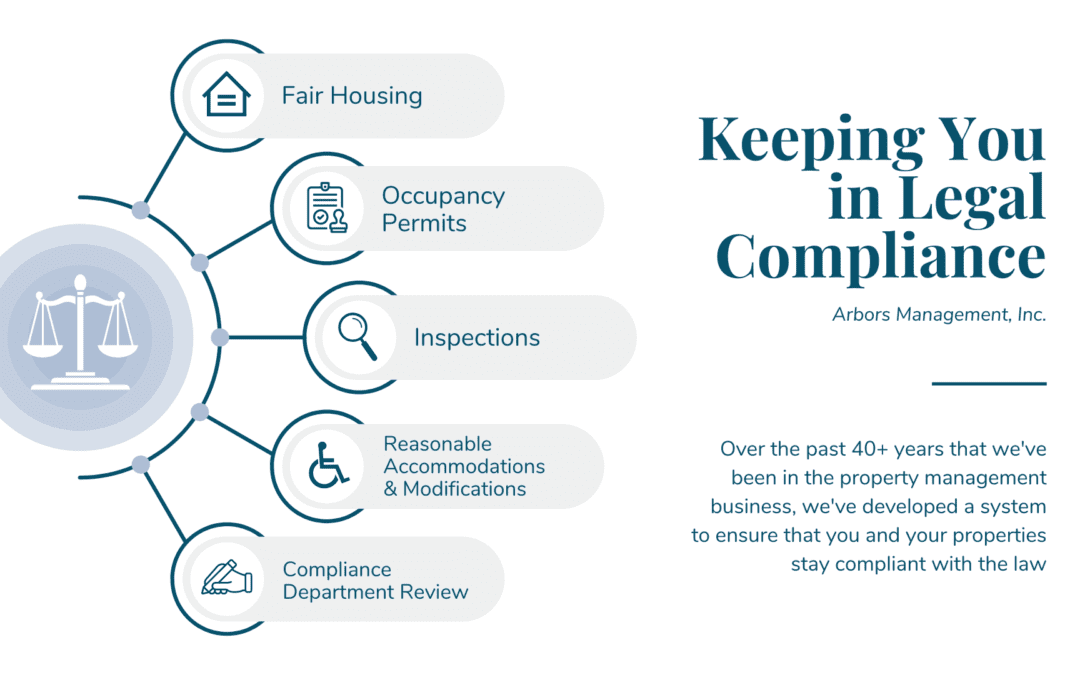
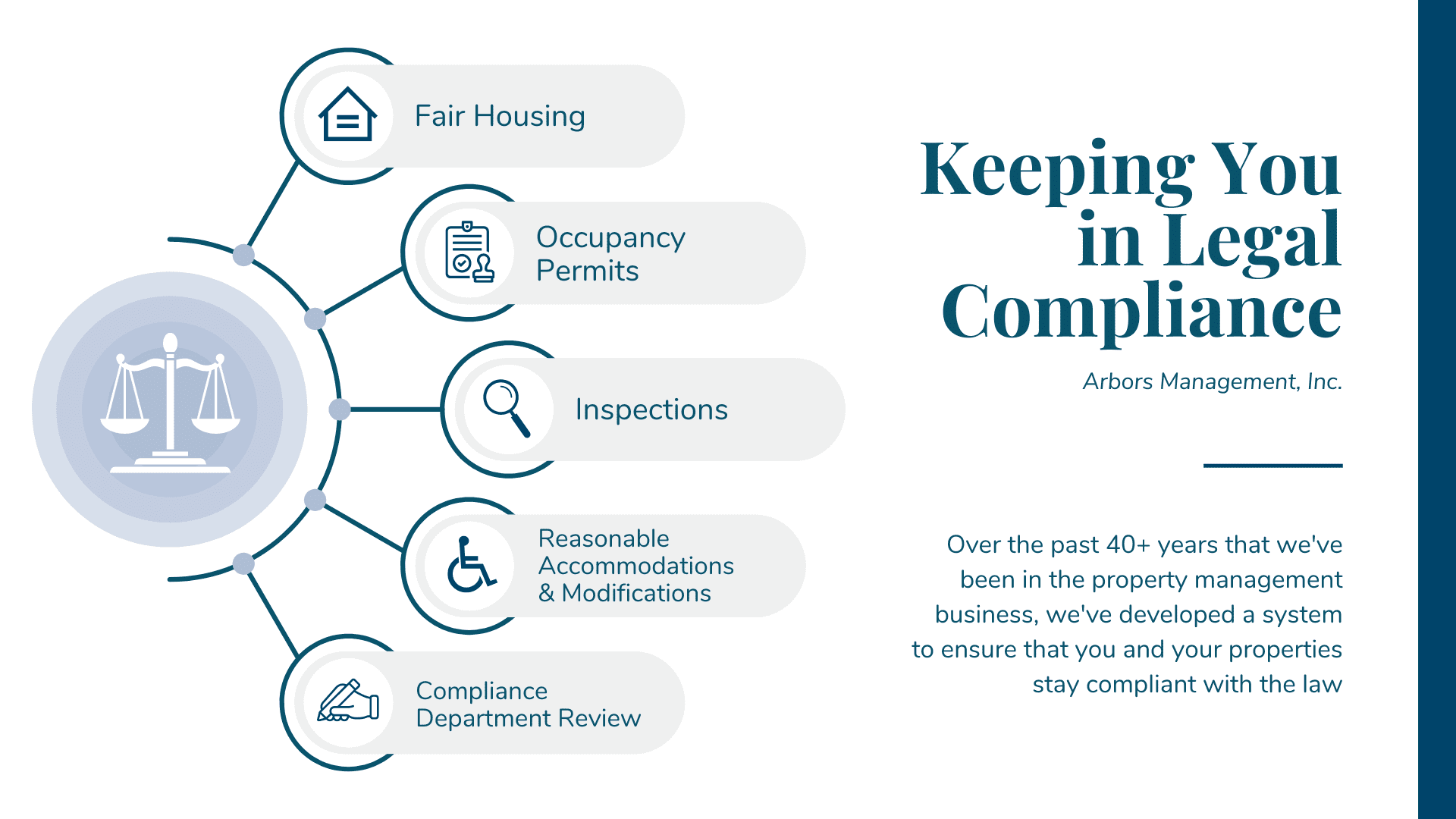
One of the most important facets of property management is maintaining legal compliance. As daunting as that can be for one owner, Arbors has a dedicated Compliance Department to ensure that you and your property are in the clear.
So how do we keep our clients legally compliant? We’ll break that down in this article over these five different categories:
- Fair Housing
- Occupancy Permits
- Inspections
- Reasonable Accommodations and Reasonable Modifications
- Compliance Department Review
1. Fair Housing
First and foremost, we want to make sure your property is compliant with fair housing regulations, one of the most important aspects of managing rental properties. How do we keep you in compliance with fair housing law?
One of the best ways for us to do this is through our screening criteria. We’ve developed our screening criteria over the 40 years that we’ve been in business and abide by that criteria on properties that we manage in order to avoid any fair housing violations.
In an effort to eliminate unfair advantage or preference among applicants, we process applications by the standards set by the Pennsylvania State Law. We also process applications in the order that they are received.
Additionally, our agents representing you have their real estate salesperson license. With this comes continuing education to ensure we stay up to date with all legal requirements and updates pertaining to keeping you compliant with local, state, and federal laws.
2. Occupancy Permits
Another way that we keep you in compliance is by keeping your property in rental housing code compliance with any state, local, or municipality housing standards. One of the items that is included in many of these local requirements is an occupancy permit or a rental registration.
If you do have a rental property under our management, we will take care of occupancy permits or rental registrations required by any local municipality or governments. This includes:
- Payment on our clients’ behalf of rental registration fees
- Coordinating and potentially attending occupancy inspections
- Arranging any repairs needed in order to stay compliant with local municipality occupancy standards
3. Inspections
We perform annual inspections – we call them interim inspections. At these inspections, we’re looking for common things at your property that are required by the local municipalities to make sure that you’re able to obtain occupancy permits. The most common things are:
- Smoke detectors
- Carbon monoxide detectors
- Handrails
- Any other obvious safety deficiencies at the property
If we do find that any of these items need attention, we will address them.
4. Reasonable Accommodations and Modifications
Occasionally, a resident may request for a reasonable accommodation or a reasonable modification to your property.
We are trained and well-versed in the requirements necessary in order to approve or deny these requests.
We will handle the proper paperwork and forms to document the request to complete everything, all while making sure – you guessed it – that you are staying in compliance by abiding by fair housing laws when accommodating or denying a request.
Here’s the difference between the two:
Reasonable Accommodation: request for a change in our policies and procedures to accommodate a resident for a need that they have.
*Responsibility of the landlord to pay
Ex: Allowing a service animal to occupy a property with a no-pet policy
Reasonable Modification: request to change the physical nature of the property to accommodate a resident for a need that they have.
*Responsibility of the resident to pay
Ex: Installing a ramp to the front entrance of a property because the resident is wheelchair bound
5. Compliance Department Review
Any new residents moving into your property will be reviewed by our Compliance Department in order to ensure that we met all of the screening criteria appropriately.
A few items that the Compliance Department review are:
- The lease
- Application
- Credit and criminal reports
- Photo identification
- Proof of income
If they do find any errors or discrepancies, our management staff will be alerted and those will be corrected as soon as possible.
Arbors Management Keeps You Compliant
With over 40 years of experience in property management in Pittsburgh, Western Pennsylvania, and West Virginia, we’ve learned a thing or two about legal compliance.
When you hire Arbors Management to manage your property, you are also hiring a dedicated Compliance Department that ensures that you and your property are operating within the bounds of the law.
If you have any questions about our professional Pittsburgh property management services, including how our Compliance Department works, please contact us through this form, or give us a call at 1 (800) 963-1280.
Disclaimer: We are not attorneys and the information herein is not intended to be legal advice. Please consult with your attorney for any matters pertaining to your specific situation.
by Nicole Scimio | Apr 15, 2022 | Blog, Property Management Education, Rent Collection, Rental Price
What Kind of Fees Can I Expect From Arbors Management?
Every property management company has a different way of working and a different way of charging management fees.
For example, you might hire a management company that charges one flat rate, or you might find a property manager who charges separately for every service that’s performed.
At Arbors Management, we have three all-inclusive fees. We do not like to piecemeal our costs, and we don’t have an upcharge on our maintenance services.
Today, we’re talking about our three fees upfront and what all you can expect when you work with us.
These fees are also similar to many of the fee structures you’ll find with property management companies in and around Pittsburgh.
Leasing Fees in Pittsburgh
Our leasing fee is the equivalent of one month’s rent, meaning the first month of rent that we collect for you will pay for our leasing services. It’s a one-time fee that’s paid at the beginning of the lease.
This fee covers everything involved in finding and placing a great resident, including:
- Marketing your property
- Showing your property
- Rent pricing
- Preparing the property for rent
We’ll also handle the application process and screen each resident thoroughly and in compliance with the fair housing laws.
Once we’ve approved a resident, we’ll take care of:
- Collecting the move-in funds
- Conducting a move-in inspection of the property to document its condition
- Executing the lease agreement
Management Fees in Pittsburgh
Then, you’ll have the monthly management fee, which is typically 9 percent of your monthly rent.
The management fee can differ depending on a few different factors:
- How many units the property has
- If we will need to employ onsite staff
- How many total properties we’re managing for you
- How much those homes are earning
- The neighborhoods in which those homes are located
Your management fee will come directly out of the rent we collect from the residents. It includes everything that’s covered in our management services, from lease enforcement to inspections to maintenance.
The management fee also covers:
- Our resident and vendor communication
- Any notices that need to be served
- Our accounting and bookkeeping
- The portals we provide for residents and owners
Lease Renewal Fees in Pittsburgh
Our final fee is a renewal fee, which is a flat $250 charge that you’ll pay each time we renew a resident.
When you think about the cost of resident turnover and vacancies, it’s easy to see what a value $250 is.
We’ll work hard to retain your residents, and the renewal fee will cover our negotiation and signing of the new lease. It costs you a lot less than it would if you were paying a new leasing fee.
In Conclusion…
There is no single right way to charge management fees, but the most important thing is that the company you’re working with is transparent and honest.
The last thing you need as an owner and investor is to be surprised by extra charges, and it’s important to review your management agreement before you sign it.
Contact us at Arbors Management if you’d like to know more about our services and their costs. Our Portfolio Managers and Leasing Specialists would be happy to provide a personalized quote that’s based on your property and its unique needs!
by Nicole Scimio | Apr 1, 2022 | Blog, Low Income Tax Credit Housing, Project Based Section 8 Housing
By: Cindy Peterle-Harris, Director of Compliance at Arbors Management
Section 8 Housing: Section 8 Vouchers vs. Project-Based Section 8 Housing
It’s likely that you’ve heard of Section 8 housing, or its two subcategories, but do you know exactly what it is?
According to this article on www.hud.gov, the Section 8 Housing program is “the federal government’s major program for assisting very low-income families, the elderly, and persons with disabilities to afford decent, safe, and sanitary housing in the private market.”
Oftentimes, there can be confusion regarding the Section 8 program, who qualifies for Section 8 housing, what it means for owners and their rental properties, and more.
Today, we’re going to try to clear up some of that confusion for owners and tenants by discussing Section 8 and breaking down the two housing programs – Section 8 Vouchers and Project-Based Section 8 Housing – that fall under that title.
Program #1: Section 8 Voucher Program
The first type of Section 8 housing is the Section 8 Voucher Program.
A Section 8 Housing Choice Voucher is a type of housing assistance that will pay a portion of the rent that is charged on a unit.
The Voucher is awarded by the local Housing Authority to a qualified applicant and can be used at any rental property that accepts Section 8 Vouchers.
Who Qualifies for the Section 8 Voucher Program?
There are income and household composition requirements that must be met to qualify, but the applicant should contact the local housing authority for more information on those requirements.
Accepting Vouchers as a Property Owner
If you’re a single-family rental property owner, you can agree to accept these Section 8 Housing Vouchers if you so choose. If you do, you will receive all or some of the rental payment directly from the housing department every month.
Many rental property owners in Pittsburgh find this to be a good strategy because it’s guaranteed rent. You won’t have to chase down residents for late rent or missing payments because you know exactly where the money is coming from – a government agency.
However, even though your rent payment is guaranteed, there are still some hoops to jump through when you accept Section 8 Vouchers at your rental property.
Your property will have to undergo several different types of inspections. If there are any habitability issues, you’ll need to fix them right away – otherwise the Voucher program will not approve you for participation.
Additionally, there can be delays with rent payments, especially if there’s a government shutdown.
There can also be a difference in market rental values. With a market-rate property, you can set the rent at whatever you want; as long as the market will bear what you’re asking, you’ll get the rental price you ask for. But with a Section 8 Voucher, you are limited to what the Section 8 program determines is the acceptable rent rate for your property.
Does Arbors Management Accept Section 8 Vouchers?
Arbors Management will accept Housing Choice vouchers for the properties that have Low Income Tax Credits attached to them: The Meadows Apartments and 38 West Prospect Road in Washington, PA.
We do not accept Vouchers for our Project-Based Section 8 or PRAC (Project Rental Assistance Contracts) properties because there is already a deep subsidy attached to the unit itself. If an applicant has a Housing Choice Voucher and moves to a Project-Based Section 8 or PRAC unit, the applicant will lose the Voucher.
When looking for housing with a Section 8 Voucher, please be sure to check with your leasing agent to see if the owner will accept a Housing Choice Voucher.
Program #2: Project-Based Section 8 Housing
Project-Based Section 8 properties have an agreement with HUD (U.S. Department of Housing and Urban Development) that HUD will pay a portion of the contract rent (the rent rate that HUD has established for the property) for qualified residents.
The resident will pay 30% of his or her adjusted gross monthly income and HUD will pay the difference between the rent paid by the resident and the contract rent on the unit.
Project-Based Section 8 Housing is a little bit different than the Voucher Program. In this case, the subsidy is attached to the property, not the person. So, funding is given out based on the property, not an individual person and their income.
Who Qualifies for Project-Based Section 8 Housing?
It all depends on the property!
Eligibility factors always include an income limit based on a percentage of the median household income. This income limit is set by the Department of Housing and Urban Development (HUD). It’s updated annually and the income limit increases for every household member living in the unit.
Other eligibility criteria include age or disability if the property is considered an elderly property, as well as number of persons that will be living in the household.
Finally, for a household to qualify for a unit in this program, the household must require at least one dollar of subsidy even if it is below the income limit for the property/household size.
The best way to discover the eligible criteria for a property is to contact the Property Manager and ask what the eligibility criteria are for it.
What Are the Differences Between the Two Programs?
While both programs provide “deep subsidy” assistance, the major difference between the two is that in the Housing Choice Voucher program, the subsidy is attached to the tenant not the unit, while in Project-Based Section 8 programs, the subsidy is attached to the unit, not the tenant.
In other words, a tenant who has a housing choice voucher may move to another location and still receive Section 8 assistance, but with a Project-Based Section 8 property, if the tenant moves he or she may not transfer the subsidy to another property.
What Are the Similarities Between the Two Programs?
For both Housing Choice Vouchers and Project-Based Section 8 units, the tenant is required to provide income, asset and expense information on an annual basis. Rent will be adjusted yearly based on the information that is provided.
It is also important to note that despite differences in requirements for each program, the purpose of the two programs remains the same: to assist low-income families, persons with disabilities, and elderly by providing comfortable, safe housing.
In Conclusion…
There are two types of Section 8 Housing: Section 8 Voucher Program and Project-Based Section 8 Housing.
While both programs are meant to help low-income families, persons with disabilities, and the elderly, they do so in different ways. Section 8 Vouchers are attached to the tenant, while the subsidy for Project-Based Section 8 Housing is tied to the unit.
Section 8 can be a confusing topic, especially if you’re not dealing with the program on a daily basis. If you have any questions, please don’t hesitate to contact us! We’d be happy to help you manage your Section 8 property or help you find an affordable place to call home.
Phone: 1(800)-963-1280
Email: monroeville@arbors.com
by Nicole Scimio | Mar 1, 2022 | Blog, Property Management Education
By: Nick Griffith, Director of Conventional Housing at Arbors Management
What Exactly Do Property Managers Do?
Today, we’ll be speaking about a very simple question that has a complex answer: What exactly do property managers do? The way we see it here at Arbors Management is that property management can be broken down into two main categories – leasing and day-to-day management, and two sub-categories – accounting and compliance.
But, just as important as what property managers do, is what we don’t do; we’ll cover that, too.
How Do We Handle Leasing?
An important part of property management is getting your property leased to a quality renter. Here at Arbors, we believe that most problems in real estate investing can be solved by placing the right, high-quality resident into each property. We perform several types of screening in order to accomplish this; criminal, credit, income, landlord, sex-offender, terrorist, and pet screening, just to name a few.
In order for us to attract the best quality residents, we need to properly market your property by highlighting its features as well as pricing it appropriately.
A good property manager will look at the surrounding market and comparables to determine the best price to rent the property quickly while also giving the owner the best return on their money. We also handle all the inquiries and showings of the property, saving you a lot of time and money.
Once the property manager has found a qualified applicant, they should have a rock-solid lease to ensure that the owner is protected. Here at Arbors, we have a completely online lease signing process, making renting from us easy and efficient.
Once the lease is signed, deposits are paid, and move-in is scheduled, a good property manager will perform a move-in inspection to record the condition of the property at the time the resident moves in. We record the inspection with photos that we can reference again later when the resident decides to move out.
Speaking of inspections, routine inspections are important to ensure your property is well maintained. At Arbors, our leasing specialists perform an interim inspection several months prior to the lease expiration to ensure we know the condition of the property prior to renewing the lease. We share that inspection with our clients along with our recommendations so they can make the best decision for them.
Day-to-Day Property Management – What Does it Look Like?
After the property has been leased and the resident has moved in, we turn to our second category of property management: the day-to-day management.
Perhaps one of the most important items a property manager can do is collect the rent. After all, rent is what allows you to maintain the property and make a profit!
At Arbors Management, we provide several ways for residents to pay their rent; through a convenient online portal, by mail, by drop box at our main office, or by electronic cash payment at several convenient-store locations.
Money management is also a very important part of property management. A property manager will need to pay the expenses on your property, oftentimes from the rent that is collected and bill the residents for any appropriate expenses for your reimbursement.
Once all the expenses are paid, the property manager should have a way to get the investor their money. Here at Arbors, we do a direct deposit into your bank account at the end of each month.
Another aspect of property management is working directly with residents. On occasion, residents will have maintenance requests, emergencies, and general questions or problems while living at the property. These could range from leaky plumbing, heating issues, loss of employment, income changes, additions to their family, or neighbor disputes.
A property manager communicates directly with residents to solve these issues so that you don’t have to. Enforcing a lease can be difficult, so it’s the property managers job to walk the line between being compassionate while also enforcing the agreement. A good property manager should bring you solutions, not problems.
Addressing maintenance issues is another important part of property managers’ duty to maintain the value of your asset. Emergencies can happen at any time, day or night, and even on the weekends.
This is why a good property manager needs to have a plan on what to do when an emergency does happen. Here at Arbors we have a 24/7 dedicated phone number for maintenance emergencies and a network of contractors that can respond quickly in order to resolve any issue that might arise.
How Do Accounting and Compliance Come Into Play?
Two other categories of property management are accounting and compliance.
As an investor, you’ll want to see where your money is being spent and when rents are collected by your property manager. At Arbors, we have a full accounting staff that generates reports so that you can easily see the income for your property, expenses, and any invoices or bills associated with those expenses.
Transparency is important, but so is legal compliance! When renting out a property, there are a lot of laws, rules, and regulations that come with it. Your property manager should know the ins and outs of what is needed at the property to ensure you stay in compliance with these requirements to keep you protected. At Arbors, we have a compliance department that makes sure we cross our t’s and dot our i’s to make sure everyone is protected.
So What Don’t We Do as a Property Management Company?
Almost as important as what property managers do, is what we don’t do. From the information above, we can safely say property managers wear many different hats.
Even though we have many different roles, we are not tax professionals, attorneys, or debt collectors. Oftentimes a property manager can recommend a specialist in each of these areas. We may know a thing or two about each of these topics, but your property manager shouldn’t get involved in areas outside their expertise.
All in All…
The answer to the question “what exactly do property managers do?” is complicated. We discussed how a property manager should handle leasing, day-to-day management, and all aspects involved in those two main categories.
We also discussed that property managers should be transparent with your money through good accounting reports and remain compliant by staying up to date with rental property requirements.
While property managers wear many hats, as they should, they are not tax professionals, attorneys, or debt collectors.
Hopefully you now have a better idea of everything that property management encompasses.
If you have any questions about property management and how Arbors Management might help you with your property(ies), please don’t hesitate to reach out to us!
Phone: 1(800)-963-1280
Email: monroeville@arbors.com


 Another hot topic is the rise of service animals and emotional support therapy animals.