What Exactly Do Property Managers Do?

What Exactly Do Property Managers Do?
By: Nick Griffith, Director of Conventional Housing at Arbors Management

What Exactly Do Property Managers Do?

Today, we’ll be speaking about a very simple question that has a complex answer: What exactly do property managers do? The way we see it here at Arbors Management is that property management can be broken down into two main categories – leasing and day-to-day management, and two sub-categories – accounting and compliance. 

But, just as important as what property managers do, is what we don’t do; we’ll cover that, too.

How Do We Handle Leasing?

An important part of property management is getting your property leased to a quality renter. Here at Arbors, we believe that most problems in real estate investing can be solved by placing the right, high-quality resident into each property. We perform several types of screening in order to accomplish this; criminal, credit, income, landlord, sex-offender, terrorist, and pet screening, just to name a few. 

In order for us to attract the best quality residents, we need to properly market your property by highlighting its features as well as pricing it appropriately. 

A good property manager will look at the surrounding market and comparables to determine the best price to rent the property quickly while also giving the owner the best return on their money. We also handle all the inquiries and showings of the property, saving you a lot of time and money. 

Once the property manager has found a qualified applicant, they should have a rock-solid lease to ensure that the owner is protected. Here at Arbors, we have a completely online lease signing process, making renting from us easy and efficient. 

Once the lease is signed, deposits are paid, and move-in is scheduled, a good property manager will perform a move-in inspection to record the condition of the property at the time the resident moves in. We record the inspection with photos that we can reference again later when the resident decides to move out. 

Speaking of inspections, routine inspections are important to ensure your property is well maintained. At Arbors, our leasing specialists perform an interim inspection several months prior to the lease expiration to ensure we know the condition of the property prior to renewing the lease. We share that inspection with our clients along with our recommendations so they can make the best decision for them.

Day-to-Day Property Management – What Does it Look Like?

After the property has been leased and the resident has moved in, we turn to our second category of property management: the day-to-day management. 

Perhaps one of the most important items a property manager can do is collect the rent. After all, rent is what allows you to maintain the property and make a profit! 

At Arbors Management, we provide several ways for residents to pay their rent; through a convenient online portal, by mail, by drop box at our main office, or by electronic cash payment at several convenient-store locations. 

Money management is also a very important part of property management. A property manager will need to pay the expenses on your property, oftentimes from the rent that is collected and bill the residents for any appropriate expenses for your reimbursement. 

Once all the expenses are paid, the property manager should have a way to get the investor their money. Here at Arbors, we do a direct deposit into your bank account at the end of each month. 

Another aspect of property management is working directly with residents. On occasion, residents will have maintenance requests, emergencies, and general questions or problems while living at the property. These could range from leaky plumbing, heating issues, loss of employment, income changes, additions to their family, or neighbor disputes. 

A property manager communicates directly with residents to solve these issues so that you don’t have to. Enforcing a lease can be difficult, so it’s the property managers job to walk the line between being compassionate while also enforcing the agreement. A good property manager should bring you solutions, not problems. 

Addressing maintenance issues is another important part of property managers’ duty to maintain the value of your asset. Emergencies can happen at any time, day or night, and even on the weekends. 

This is why a good property manager needs to have a plan on what to do when an emergency does happen. Here at Arbors we have a 24/7 dedicated phone number for maintenance emergencies and a network of contractors that can respond quickly in order to resolve any issue that might arise.

How Do Accounting and Compliance Come Into Play?

Two other categories of property management are accounting and compliance. 

As an investor, you’ll want to see where your money is being spent and when rents are collected by your property manager. At Arbors, we have a full accounting staff that generates reports so that you can easily see the income for your property, expenses, and any invoices or bills associated with those expenses. 

Transparency is important, but so is legal compliance! When renting out a property, there are a lot of laws, rules, and regulations that come with it. Your property manager should know the ins and outs of what is needed at the property to ensure you stay in compliance with these requirements to keep you protected. At Arbors, we have a compliance department that makes sure we cross our t’s and dot our i’s to make sure everyone is protected.

So What Don’t We Do as a Property Management Company?

Almost as important as what property managers do, is what we don’t do. From the information above, we can safely say property managers wear many different hats. 

Even though we have many different roles, we are not tax professionals, attorneys, or debt collectors. Oftentimes a property manager can recommend a specialist in each of these areas. We may know a thing or two about each of these topics, but your property manager shouldn’t get involved in areas outside their expertise. 

All in All…

The answer to the question “what exactly do property managers do?” is complicated. We discussed how a property manager should handle leasing, day-to-day management, and all aspects involved in those two main categories. 

We also discussed that property managers should be transparent with your money through good accounting reports and remain compliant by staying up to date with rental property requirements. 

While property managers wear many hats, as they should, they are not tax professionals, attorneys, or debt collectors. 

Hopefully you now have a better idea of everything that property management encompasses. 

If you have any questions about property management and how Arbors Management might help you with your property(ies), please don’t hesitate to reach out to us!

Phone: 1(800)-963-1280

Email: monroeville@arbors.com 
How Using Third-Party Maintenance Vendors Comes in Handy

How Using Third-Party Maintenance Vendors Comes in Handy

Maintaining Your Property

Routine repairs and emergency maintenance are not uncommon when you’re renting out a property. 

When purchasing an investment home, you need to have a maintenance budget and a maintenance plan in place. 

Owning an investment property doesn’t necessarily mean you personally know how or have the tools to fix maintenance issues when they arise.

This is when hiring professional third-party maintenance vendors comes in handy.


Network of Preferred Vendors

A big part of your maintenance plan should be the vendors you’re going to use on a regular basis.

Vendors you hire should be ones you trust, who are reliable, and have a good reputation. 

These are who we refer to as “preferred vendors.” 

Keeping a list of preferred vendors will ensure your property is well-maintained and your residents are happy.

When you work with a professional property management company, you’ll either have access to their vendor resources or you’ll use the in-house maintenance team they employ. 

Some companies will use both in-house maintenance team members and third-party vendors. 

Before you hire a property manager, find out how they approach maintenance and why it works for their clients.

At Arbors Management, we currently work with third-party vendors. 

Today, we’re talking about how they help us deliver high-quality and low-cost repair services to our owners and their properties.


Working with Professional Maintenance Vendors and Contractors

Whether it’s a routine issue or a middle-of-the-night emergency, we are happy with our team of qualified vendors and contractors. 

We screen our vendors thoroughly before we agree to work with anyone; we check to be sure that the vendors are licensed, insured, and properly vetted. 

This is important; hiring an unlicensed vendor can put you in a lot of legal risk. 

If that worker falls off a ladder at your home, you could be held responsible for the medical care he or she requires.

It is also important to look for vendors who are experienced in the type of work they’re doing. Certain repairs will require a specialist such as a plumber or an electrician. 

And, just as crucial as the vendor being knowledgeable and legally capable, make sure that they will treat your residents and your property with respect and care.


Accessing Preferred Maintenance Pricing

One of the major benefits of having a large network of vendors like ours is that we’re able to provide our clients discounted pricing. 

This pricing helps our clients to save money. We don’t up-charge for our maintenance services, so when our vendors offer us reduced rates because of volume economics, we pass those savings right onto our clients.

Another benefit we earn because of the amount of work we provide our vendors is that we get priority service.

The priority service we receive helps when there’s an emergency or it happens to be a busy time of year. We’ll still be at the top of their lists when we need something done. 


In Conclusion

We would love to tell you more about the vendors we work with, how we choose them, and why it pays to have access to reliable, affordable maintenance through professional property managers. 

We have great relationships with vendors and contractors who specialize in a number of different areas, and we’ve worked with them for many years. 

So whether your property needs a plumber, HVAC tech, roofer, general contractor, or handyman, we have you covered!

Please contact us at Arbors Management to discuss how we can help you with all of your property management needs in Pittsburgh, Western PA, West Virginia, and surrounding areas.


Pittsburgh, PA Markets and Sub-markets: Where to Invest

Pittsburgh, PA Markets and Sub-markets: Where to Invest

The Pittsburgh Housing Market

There are plenty of excellent reasons to invest in Real Estate in Pittsburgh

  • Pittsburgh is diverse
  • Pittsburgh is growing and desirable
  • Plenty of good school districts nearby
  • Pittsburgh real estate is generally affordable

The list could go on and on!

Whether you’re local to the area or from out of state and looking for an investment property, you can find some thriving submarkets in and around Pittsburgh. 

Today, we’re talking about what you should buy and where you should buy when considering a Pittsburgh investment property.


Investing in Pittsburgh: Market Strength

Housing prices are on the rise in Pittsburgh, but the buy-in that investors face is still much lower than in other east coast cities. 

Pittsburgh neighborhoods have undergone a lot of revitalization in the last few years, and the economy is growing. 

More people are moving into the area and unemployment is lower than the state average. 

There’s a growing tech industry in the city thanks to companies like Google, Apple, Uber, and Facebook setting up shop. 

The medical centers and universities are putting Pittsburgh on the map in new ways, and smart investors are taking note.


Pittsburgh Neighborhoods to Consider

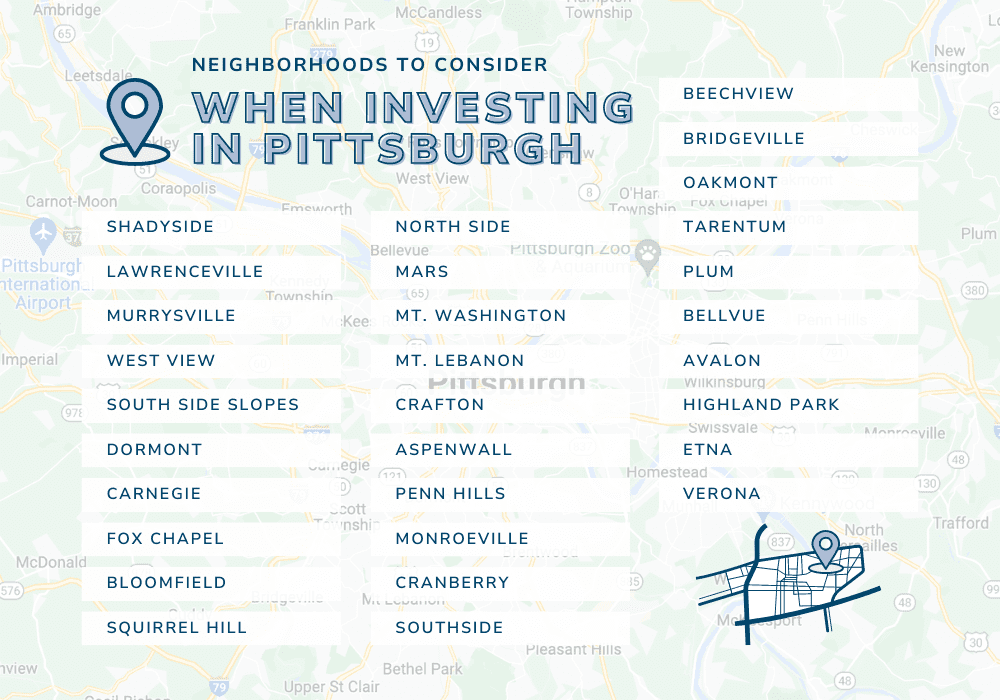
When you’re looking for a Pittsburgh investment property, you’ll need to consider your investment goals and the importance of location. 

When we’re talking to investors, whether they’re looking for their first rental home or an additional property to add to a growing portfolio, we always recommend neighborhoods with outstanding resident pools and the potential for long term gains. 

Some of those neighborhoods we recommend are:


Pittsburgh Neighborhoods to Avoid

As your property management partners, we care about the investment decisions that you make and are happy to be involved from the beginning. 

If you’re considering purchasing a home in Pittsburgh, reach out to us to get our insights on the neighborhood – we’ll give you our honest feedback.


Types of Homes to Buy

When you’re looking for a great investment property in Pittsburgh, remember that your goal is to get it onto the market as soon as possible – an unoccupied rental home is an expensive rental home. 

So, look for properties that are in good shape. 

Cosmetic upgrades often just take a few days, and it’s fine to buy a home that needs new paint or better flooring. 

Don’t bother with properties that will require heavy renovations and rehab work; you’ll lose too much money on vacancy costs, and you may not recoup what you spend bringing it up to habitability standards.


40+ Years of Experience in the Pittsburgh Housing Market

With over 40 years of experience in the Pittsburgh housing market, we’ve learned a thing or two – we’d be more than happy to discuss your options as a potential or current owner in Western Pennsylvania!

For more information or a free consultation, please contact us at Arbors Management.