by Nicole Scimio | Nov 8, 2023 | Uncategorized
Should Residents Be Allowed to Do Their Own Maintenance?
As an investment property owner, you’ve probably had at least a minor maintenance issue or two at your property.
And once your resident notified you of this minor issue, chances are that you were met with the statement:
“I don’t want to wait for a vendor to come out. Can’t I just repair this myself?”
Well, that depends.
Essentially, the blanket answer is no, but there are exceptions to every rule.
Professional Maintenance of Your Property
When it comes to the maintenance of your property, you want to ensure that you’re utilizing skilled professionals that know what they’re doing.
If you allow your resident to perform repairs at the property, a couple of less-than-desirable outcomes could occur:
- They don’t do the repair correctly, causing you additional maintenance and additional expense
- The resident can damage your property if repairs are done improperly
- The resident gets hurt while performing maintenance, which causes a liability to you as an owner
But when using a professional, you have the peace of mind that they can perform skilled work because they’ve been trained in it.
The cost is a little higher up front, but will ultimately save you money in the long run.
Licensed & Insured Vendors
An important item to note is that you want to ensure that the vendors you work with have appropriate insurance and licensing in their field.
If the vendor you hire does something wrong, damages property, gets hurt, etc. their insurance will cover it.
With hiring properly licensed & insured vendors, your liability is greatly reduced in a number of ways.
Examples of Maintenance that Residents Should NOT Do:
- Any major mechanical repairs involving:
- Plumbing
- HVAC
- Appliance
- Electrical
- Roof repairs
- Flooring/carpet installation
- Siding or window repairs
- Gutter clean out
- Lawn maintenance and snow removal when there are multiple units at a property
This isn’t an exhaustive list of everything that residents shouldn’t do maintenance-wise.
However, it does serve as a brief summary of some of the most important items that you don’t want to risk a resident handling themselves.
Examples of Maintenance that Residents Can/Should Do:
- Small routine maintenance that would be expected when living in a home
- Change out a furnace filter
- Water filter
- Changing light bulbs
- Lawn maintenance for a single-family home
- Cutting grass, trimming trees, shrubs, etc.
- Snow removal for a single-family home
At times, an item may need to be purchased to aid in small routine maintenance, like a dehumidifier or space heater.
You can allow the resident to purchase the item, provide you a receipt, and you can reimburse them if there is a need for that specific item (that doesn’t require professional installation).
Any good lease (like ours) covers these topics and puts the responsibility on the resident for these routine service items.
Overall…
It’s in your best interest to hire professionals to handle most major maintenance items/repairs at your property.
Professionals are best when considering liability concerns, properly done maintenance, and long-term care of your property.
After all, your property is a big asset that you want to protect.
But, with that being said, there are always a few minor things that the resident should be responsible for outlined above.
The list does not include anything major, but just what would be regularly expected of someone occupying a home.
If you’d like to discuss any of this, please contact us about your specific situation. We’d be happy to walk through your situation and property needs with you!
by Nicole Scimio | Nov 3, 2023 | Uncategorized
What to Do When an Evicted Resident Leaves Belongings Behind
Evictions: Unfortunate, But Sometimes Unavoidable
As you may know, evictions are an occasional obstacle that we deal with in property management.
Maybe you’ve dealt with an eviction before as an owner, and maybe you haven’t.
If you haven’t had any experience with evictions, check out our blog post on the timeline of an eviction.
In that post, we detail out the course of the whole eviction process.
But, whether you’ve had to evict a resident before or not, you may have asked yourself the question:
“What do I do if the resident I evicted leaves their belongings behind in my property?”
While each eviction case is unique, we’ll try to break this part of the process down into the simplest terms.
What to Do if the Evicted Resident DOES Contact You
Chances are, the evicted resident will want at least some of their belongings back.
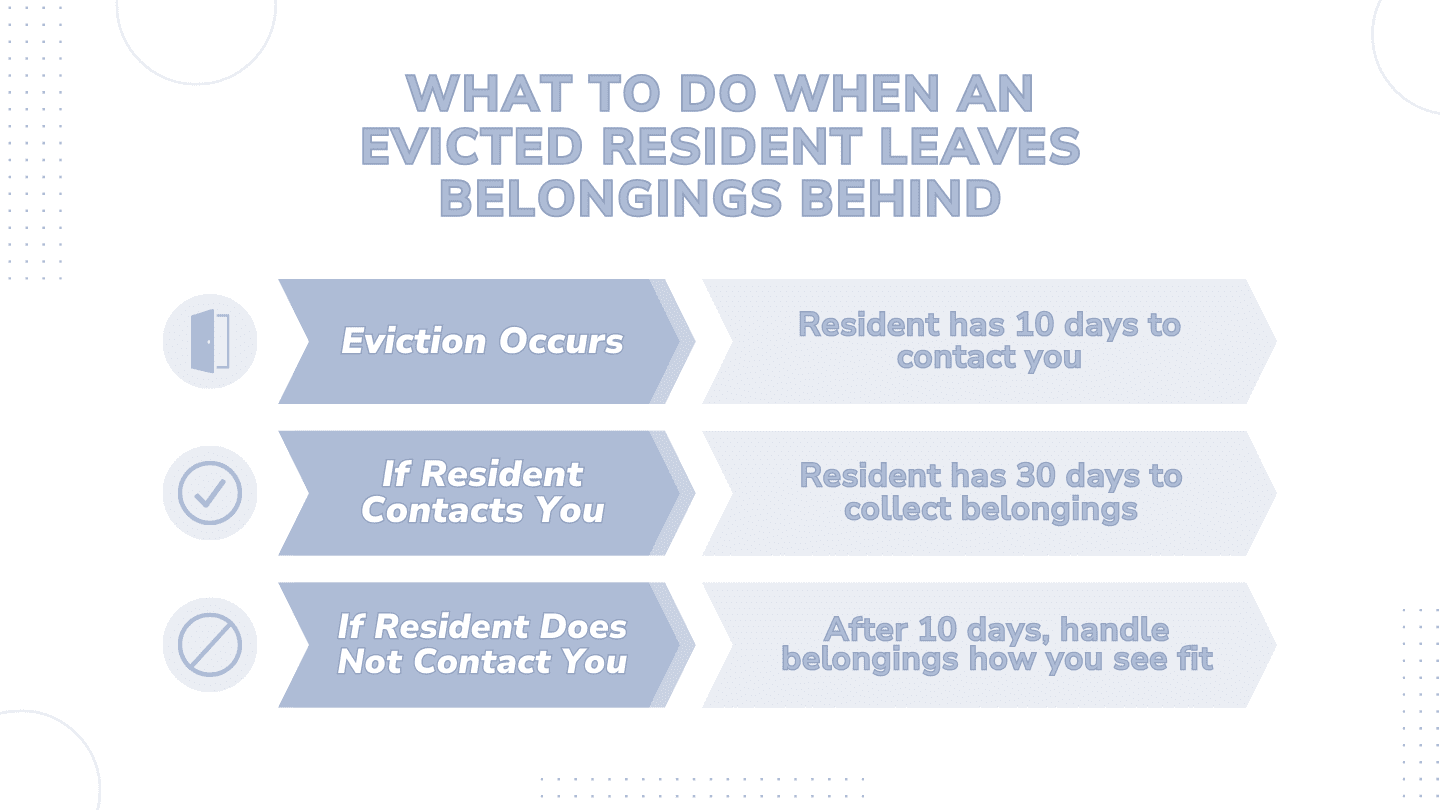
If that’s the case, the resident has 10 days to contact you and let you know that they’d like to retrieve their belongings.
If they do contact you, you must arrange for them to have access to gather their personal property within 30 days.
Note: This 30 day period begins the day of the eviction.
Once you’ve confirmed that they’ve retrieved everything they want, you’re legally allowed to do what you see fit with the the items that they leave behind.
What to Do if the Evicted Resident Does NOT Contact You
If the evicted resident fails to contact you within the initial 10 days, they forfeit their right to retrieve their belongings.
After the 10 day period of no contact, you are allowed to do what you see fit with the items they left behind.
However, to be on the safe side, we recommend you hold onto their items for the full 30 day period.
In Simplest Terms:
Eviction occurs → Resident has 10 days to contact you
If you are contacted → Resident has 30 days to get their belongings
If you are not contacted → After 10 days, you can handle their belongings how you see fit
All in All…
While evictions are not a “fun” part of owning a rental property, they do come with the territory.
The good news is that we can help!
We’ve gained expertise in all aspects of property management, including evictions, over the past 40+ years that we’ve been in business.
Contact us today for a free consultation to discuss your unique situation!
Disclaimer: We are not attorneys, and this is not to be considered legal advice. We encourage you to contact your attorney for guidance on your particular situation. This article is meant to provide a general rule or procedure on how this process works.
This is the process as we understand it in Pennsylvania and may not pertain to other states or specific cities within Pennsylvania. We always encourage a consultation with a local attorney who knows and understands Landlord Tenant Law for specific locations.
by Nicole Scimio | Dec 5, 2022 | Blog, Property Management Education, Tenant Education
By: Nick Griffith & Nicole Fandel, Director of Conventional Housing and Marketing Specialist
How We Keep Our Clients in Compliance with the Law
One of the most important facets of property management is maintaining legal compliance. As daunting as that can be for one owner, Arbors has a dedicated Compliance Department to ensure that you and your property are in the clear.
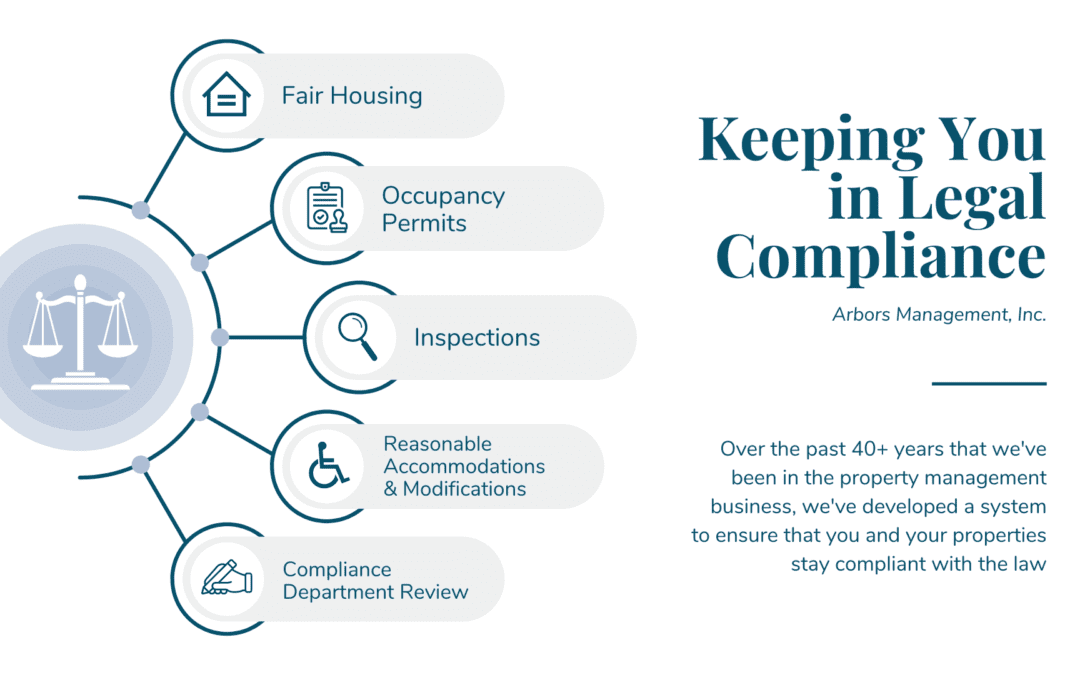
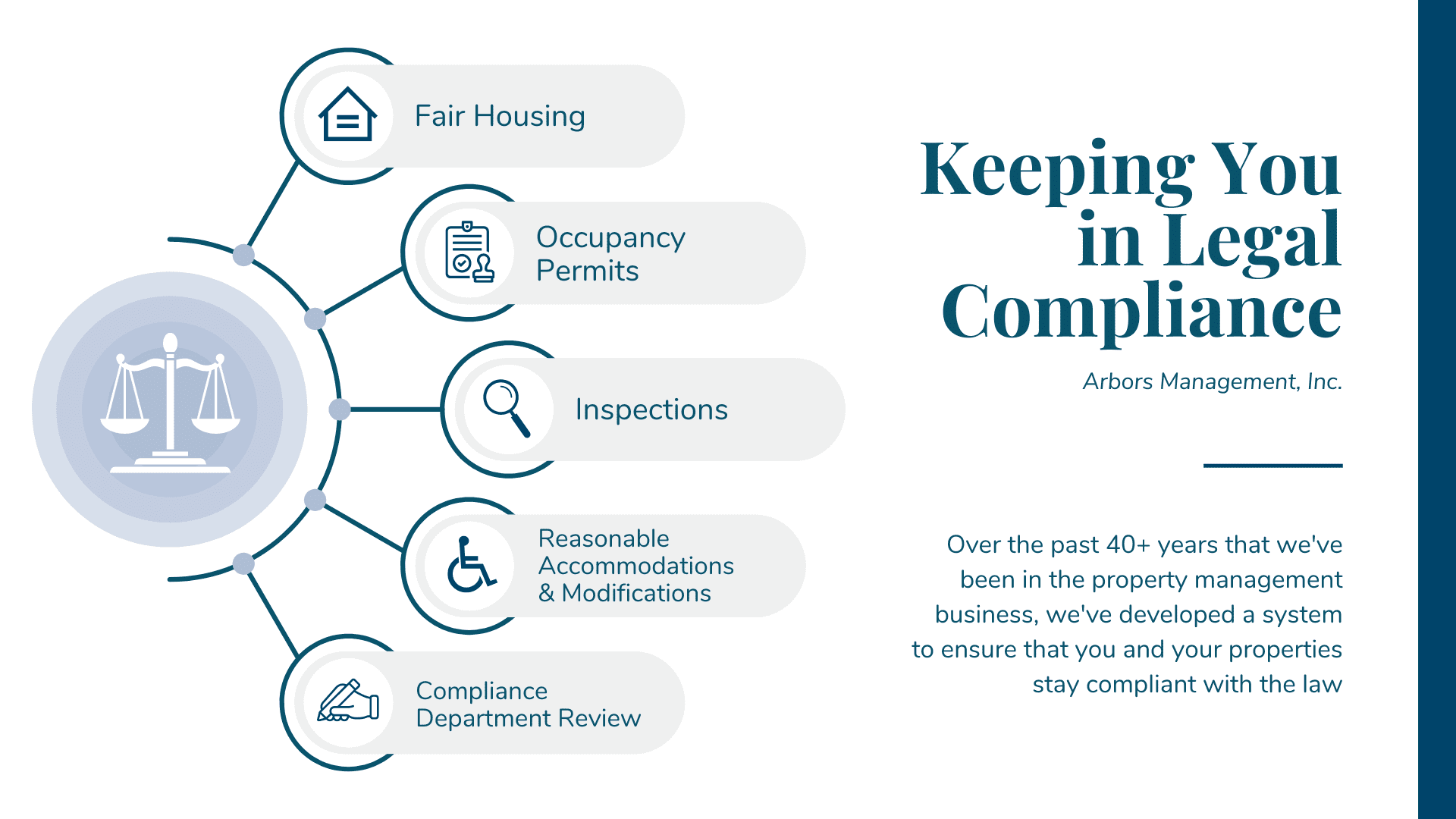
So how do we keep our clients legally compliant? We’ll break that down in this article over these five different categories:
- Fair Housing
- Occupancy Permits
- Inspections
- Reasonable Accommodations and Reasonable Modifications
- Compliance Department Review
1. Fair Housing
First and foremost, we want to make sure your property is compliant with fair housing regulations, one of the most important aspects of managing rental properties. How do we keep you in compliance with fair housing law?
One of the best ways for us to do this is through our screening criteria. We’ve developed our screening criteria over the 40 years that we’ve been in business and abide by that criteria on properties that we manage in order to avoid any fair housing violations.
In an effort to eliminate unfair advantage or preference among applicants, we process applications by the standards set by the Pennsylvania State Law. We also process applications in the order that they are received.
Additionally, our agents representing you have their real estate salesperson license. With this comes continuing education to ensure we stay up to date with all legal requirements and updates pertaining to keeping you compliant with local, state, and federal laws.
2. Occupancy Permits
Another way that we keep you in compliance is by keeping your property in rental housing code compliance with any state, local, or municipality housing standards. One of the items that is included in many of these local requirements is an occupancy permit or a rental registration.
If you do have a rental property under our management, we will take care of occupancy permits or rental registrations required by any local municipality or governments. This includes:
- Payment on our clients’ behalf of rental registration fees
- Coordinating and potentially attending occupancy inspections
- Arranging any repairs needed in order to stay compliant with local municipality occupancy standards
3. Inspections
We perform annual inspections – we call them interim inspections. At these inspections, we’re looking for common things at your property that are required by the local municipalities to make sure that you’re able to obtain occupancy permits. The most common things are:
- Smoke detectors
- Carbon monoxide detectors
- Handrails
- Any other obvious safety deficiencies at the property
If we do find that any of these items need attention, we will address them.
4. Reasonable Accommodations and Modifications
Occasionally, a resident may request for a reasonable accommodation or a reasonable modification to your property.
We are trained and well-versed in the requirements necessary in order to approve or deny these requests.
We will handle the proper paperwork and forms to document the request to complete everything, all while making sure – you guessed it – that you are staying in compliance by abiding by fair housing laws when accommodating or denying a request.
Here’s the difference between the two:
Reasonable Accommodation: request for a change in our policies and procedures to accommodate a resident for a need that they have.
*Responsibility of the landlord to pay
Ex: Allowing a service animal to occupy a property with a no-pet policy
Reasonable Modification: request to change the physical nature of the property to accommodate a resident for a need that they have.
*Responsibility of the resident to pay
Ex: Installing a ramp to the front entrance of a property because the resident is wheelchair bound
5. Compliance Department Review
Any new residents moving into your property will be reviewed by our Compliance Department in order to ensure that we met all of the screening criteria appropriately.
A few items that the Compliance Department review are:
- The lease
- Application
- Credit and criminal reports
- Photo identification
- Proof of income
If they do find any errors or discrepancies, our management staff will be alerted and those will be corrected as soon as possible.
Arbors Management Keeps You Compliant
With over 40 years of experience in property management in Pittsburgh, Western Pennsylvania, and West Virginia, we’ve learned a thing or two about legal compliance.
When you hire Arbors Management to manage your property, you are also hiring a dedicated Compliance Department that ensures that you and your property are operating within the bounds of the law.
If you have any questions about our professional Pittsburgh property management services, including how our Compliance Department works, please contact us through this form, or give us a call at 1 (800) 963-1280.
Disclaimer: We are not attorneys and the information herein is not intended to be legal advice. Please consult with your attorney for any matters pertaining to your specific situation.
by Nicole Scimio | Jun 22, 2022 | Blog, Press Releases
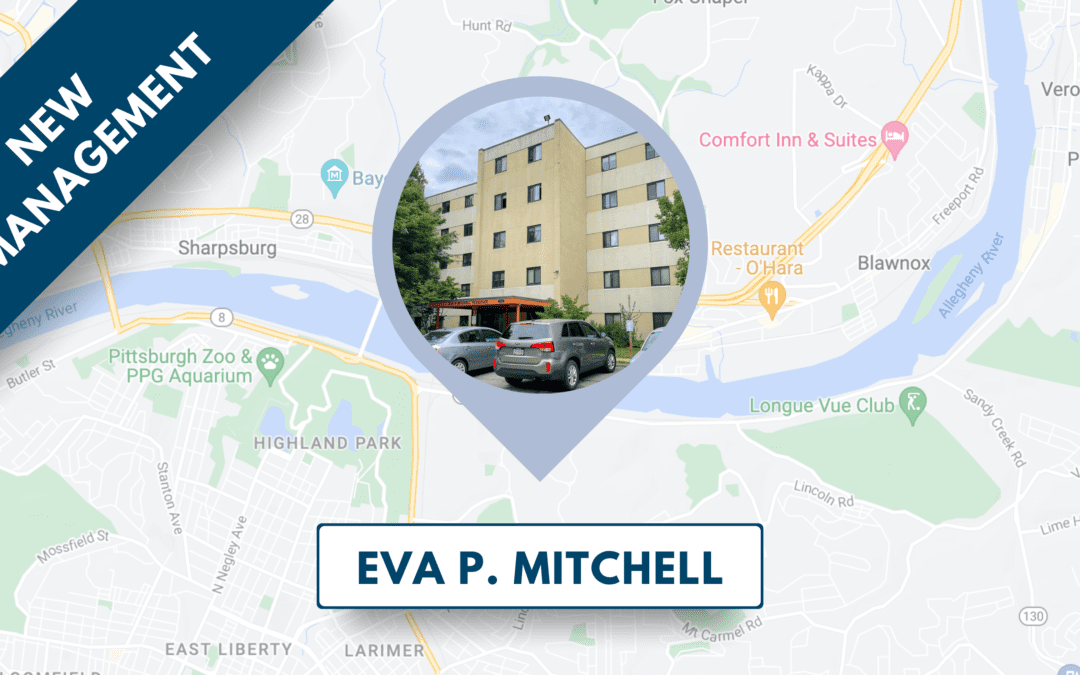
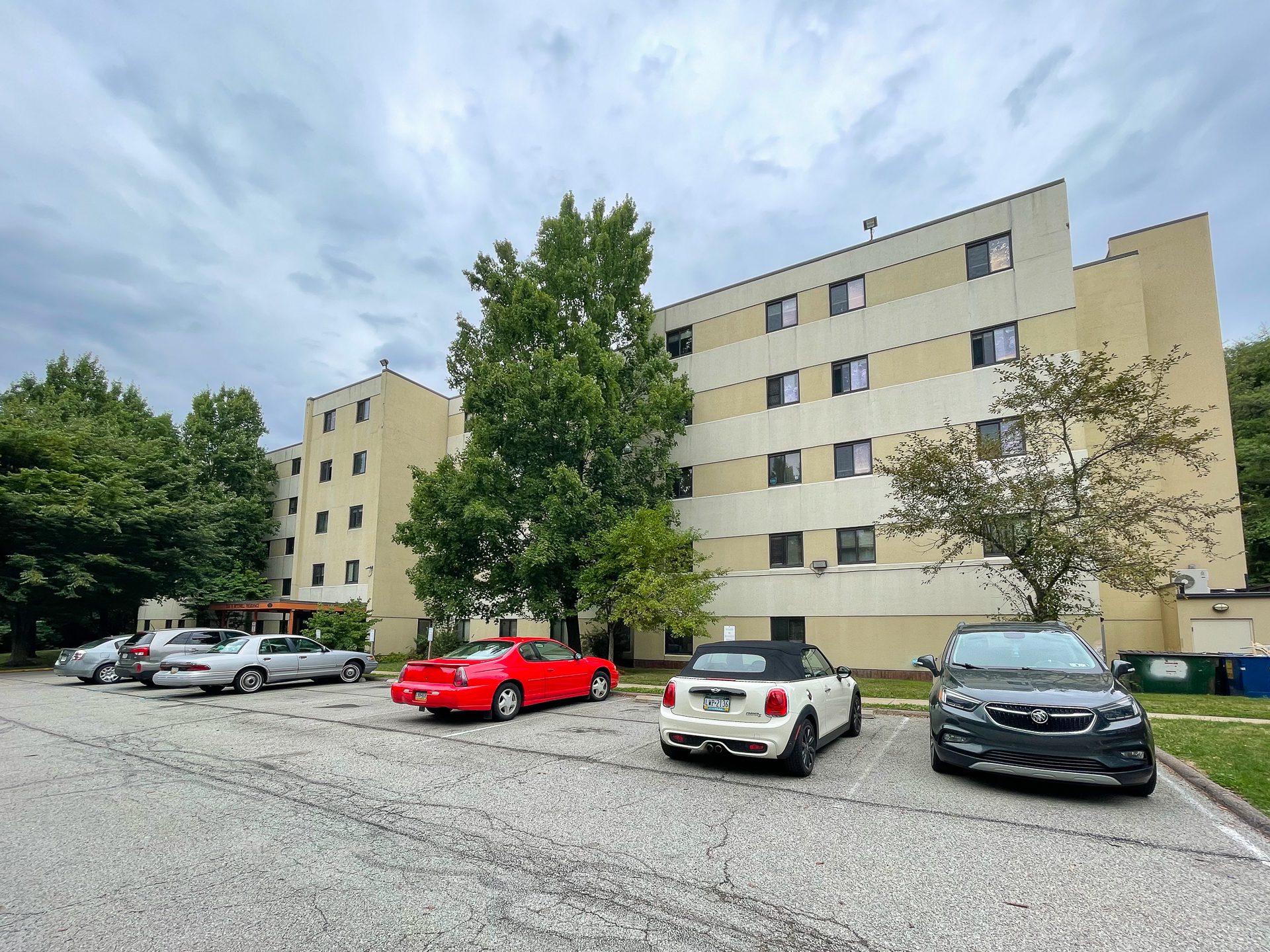
PITTSBURGH, PA – Arbors Management, Inc. is excited to announce that they are the new management agent of the Eva P. Mitchell building in Allegheny County, Pennsylvania, as of May 24th, 2022. The property is located at 7113 Mary Peck Bond Place, Pittsburgh, PA, conveniently close to Lincoln Park, Highland Park, the Allegheny River, downtown shopping, and so much more. The Mitchell building, which was originally the historic Lemington Center built in 1883, is an affordable housing complex designated for elderly and persons with disabilities with 81 one bedroom efficiency units.
“We are very excited to be working with Eva P. Mitchell to continue the important work of providing affordable housing to the residents of the city of Pittsburgh,” said Christopher Wagner, President of Arbors Management, Inc. Pittsburgh has always been a lively and welcoming city, and has only grown in popularity over the years. “It’s no secret why people are moving to Pittsburgh left and right,” Christopher continued. “It’s an incredibly diverse city with plenty to offer for everyone who calls Pittsburgh ‘home,’ as well as visitors.” With plenty of public transportation, parks, shopping, grocery stores, and entertainment around every corner, the opportunities for the residents of Eva P. Mitchell and Pittsburgh alike are endless.
Beginning in 1982, Arbors Management, Inc. has built a portfolio of over 4,000 residential units with a large majority in the affordable housing segment across Western PA and West Virginia and continues to grow. The team at Arbors Management is looking forward to building a lasting relationship with the community at Eva P. Mitchell.
Read the article online here, or read it in print in the Pittsburgh Business Times on July 8th, 2022.
If you’d like to learn more about how Arbors can help you manage your property, please contact us.
by Nicole Scimio | Apr 1, 2022 | Blog, Low Income Tax Credit Housing, Project Based Section 8 Housing
By: Cindy Peterle-Harris, Director of Compliance at Arbors Management
Section 8 Housing: Section 8 Vouchers vs. Project-Based Section 8 Housing
It’s likely that you’ve heard of Section 8 housing, or its two subcategories, but do you know exactly what it is?
According to this article on www.hud.gov, the Section 8 Housing program is “the federal government’s major program for assisting very low-income families, the elderly, and persons with disabilities to afford decent, safe, and sanitary housing in the private market.”
Oftentimes, there can be confusion regarding the Section 8 program, who qualifies for Section 8 housing, what it means for owners and their rental properties, and more.
Today, we’re going to try to clear up some of that confusion for owners and tenants by discussing Section 8 and breaking down the two housing programs – Section 8 Vouchers and Project-Based Section 8 Housing – that fall under that title.
Program #1: Section 8 Voucher Program
The first type of Section 8 housing is the Section 8 Voucher Program.
A Section 8 Housing Choice Voucher is a type of housing assistance that will pay a portion of the rent that is charged on a unit.
The Voucher is awarded by the local Housing Authority to a qualified applicant and can be used at any rental property that accepts Section 8 Vouchers.
Who Qualifies for the Section 8 Voucher Program?
There are income and household composition requirements that must be met to qualify, but the applicant should contact the local housing authority for more information on those requirements.
Accepting Vouchers as a Property Owner
If you’re a single-family rental property owner, you can agree to accept these Section 8 Housing Vouchers if you so choose. If you do, you will receive all or some of the rental payment directly from the housing department every month.
Many rental property owners in Pittsburgh find this to be a good strategy because it’s guaranteed rent. You won’t have to chase down residents for late rent or missing payments because you know exactly where the money is coming from – a government agency.
However, even though your rent payment is guaranteed, there are still some hoops to jump through when you accept Section 8 Vouchers at your rental property.
Your property will have to undergo several different types of inspections. If there are any habitability issues, you’ll need to fix them right away – otherwise the Voucher program will not approve you for participation.
Additionally, there can be delays with rent payments, especially if there’s a government shutdown.
There can also be a difference in market rental values. With a market-rate property, you can set the rent at whatever you want; as long as the market will bear what you’re asking, you’ll get the rental price you ask for. But with a Section 8 Voucher, you are limited to what the Section 8 program determines is the acceptable rent rate for your property.
Does Arbors Management Accept Section 8 Vouchers?
Arbors Management will accept Housing Choice vouchers for the properties that have Low Income Tax Credits attached to them: The Meadows Apartments and 38 West Prospect Road in Washington, PA.
We do not accept Vouchers for our Project-Based Section 8 or PRAC (Project Rental Assistance Contracts) properties because there is already a deep subsidy attached to the unit itself. If an applicant has a Housing Choice Voucher and moves to a Project-Based Section 8 or PRAC unit, the applicant will lose the Voucher.
When looking for housing with a Section 8 Voucher, please be sure to check with your leasing agent to see if the owner will accept a Housing Choice Voucher.
Program #2: Project-Based Section 8 Housing
Project-Based Section 8 properties have an agreement with HUD (U.S. Department of Housing and Urban Development) that HUD will pay a portion of the contract rent (the rent rate that HUD has established for the property) for qualified residents.
The resident will pay 30% of his or her adjusted gross monthly income and HUD will pay the difference between the rent paid by the resident and the contract rent on the unit.
Project-Based Section 8 Housing is a little bit different than the Voucher Program. In this case, the subsidy is attached to the property, not the person. So, funding is given out based on the property, not an individual person and their income.
Who Qualifies for Project-Based Section 8 Housing?
It all depends on the property!
Eligibility factors always include an income limit based on a percentage of the median household income. This income limit is set by the Department of Housing and Urban Development (HUD). It’s updated annually and the income limit increases for every household member living in the unit.
Other eligibility criteria include age or disability if the property is considered an elderly property, as well as number of persons that will be living in the household.
Finally, for a household to qualify for a unit in this program, the household must require at least one dollar of subsidy even if it is below the income limit for the property/household size.
The best way to discover the eligible criteria for a property is to contact the Property Manager and ask what the eligibility criteria are for it.
What Are the Differences Between the Two Programs?
While both programs provide “deep subsidy” assistance, the major difference between the two is that in the Housing Choice Voucher program, the subsidy is attached to the tenant not the unit, while in Project-Based Section 8 programs, the subsidy is attached to the unit, not the tenant.
In other words, a tenant who has a housing choice voucher may move to another location and still receive Section 8 assistance, but with a Project-Based Section 8 property, if the tenant moves he or she may not transfer the subsidy to another property.
What Are the Similarities Between the Two Programs?
For both Housing Choice Vouchers and Project-Based Section 8 units, the tenant is required to provide income, asset and expense information on an annual basis. Rent will be adjusted yearly based on the information that is provided.
It is also important to note that despite differences in requirements for each program, the purpose of the two programs remains the same: to assist low-income families, persons with disabilities, and elderly by providing comfortable, safe housing.
In Conclusion…
There are two types of Section 8 Housing: Section 8 Voucher Program and Project-Based Section 8 Housing.
While both programs are meant to help low-income families, persons with disabilities, and the elderly, they do so in different ways. Section 8 Vouchers are attached to the tenant, while the subsidy for Project-Based Section 8 Housing is tied to the unit.
Section 8 can be a confusing topic, especially if you’re not dealing with the program on a daily basis. If you have any questions, please don’t hesitate to contact us! We’d be happy to help you manage your Section 8 property or help you find an affordable place to call home.
Phone: 1(800)-963-1280
Email: monroeville@arbors.com