Near the end of every residency, you need to ask yourself whether or not you want to renew your resident’s lease.
Today, we’re talking about what you should consider when you’re making this decision.
Is Your Resident Paying Their Rent on Time?
One factor to consider when you’re thinking about renewing a resident’s lease is if they pay their rent on time.
If they pay on time consistently each month and you’ve never had to send a reminder or ask where their payment is, that’s great – it’s a good reason to renew the lease!
If they pay a few days late every month but they always pay, you might find it tolerable since you’d get to collect a late fee.
The tardy payments may be inconvenient, but if you like the extra income that late fees provide, renewing with a resident who pays a little bit late may work out well for you.
Is Your Resident Taking Care of the Property?
Another point to look at is how well the resident keeps up with property maintenance and cleaning.
If you’re consistently receiving maintenance requests because things are breaking or are being damaged, you might not want to keep such residents in your property.
It’s a good idea to do an inspection before you decide on a lease renewal – this will give you an opportunity to look at the condition of your property and evaluate the resident’s living conditions.
If you see damage, pests, or indications that the resident may be violating your lease agreement, there’s a good chance that you may not want to renew.
But if everything looks like it did at the beginning of the lease term, a renewal probably makes sense!
Will You Increase Your Rent?
Lease renewal is a good time to increase rent, which is another decision you’ll have to make when you’re renewing your resident’s lease.
How much can you increase without chasing the resident out?
You’ll need to do a market analysis to know what other residents are paying in rent for properties similar to yours.
If they’re not paying significantly more, you might want to leave the rent where it is so you can retain your high quality residents and avoid turnover expenses.
How Does Arbors Management Help?
Here at Arbors, we conduct a physical inspection of a property 120 to 150 days before the lease expires.
Then, we send the report to the owner through our online portal. You’ll have a chance to review the inspection report and our recommendations for how much rent should be increased.
You can review that information and decide if you agree, if you’d like to make a different rental increase, or if you don’t want to do one at all.
You can also tell us if you’d rather not renew the current resident’s lease – we’re here to move forward with what you want to do.
Once we have confirmation on how to proceed, we’ll coordinate with the resident and send them the paperwork to successfully complete the renewal process, if you so choose.
All in All…
Deciding whether or not to renew your current resident’s lease can be challenging, but when it comes down to it, you really just need to consider 3 big questions:
Does your resident pay their rent on time?
Is your resident caring for your property?
Do you plan on increasing your rent?
Once you work through those questions, whether it be on your own or with professional guidance from Arbors, you should be able to reach a sound decision.
If you need help deciding whether or not to renew your resident’s lease,contact usat Arbors Management – we’d be more than happy to help!
By: Nick Griffith, Director of Conventional Housing
At Arbors Management, we believe the best way to avoid the eviction process and troublesome residents is by conducting a strict screening process before a resident even moves in.
Our resident screening process includes a close look at income, criminal histories, and credit histories. We have a rent collection process that works, and if eviction becomes necessary – we have a process for that, too.
Collecting Rent from Pittsburgh Residents
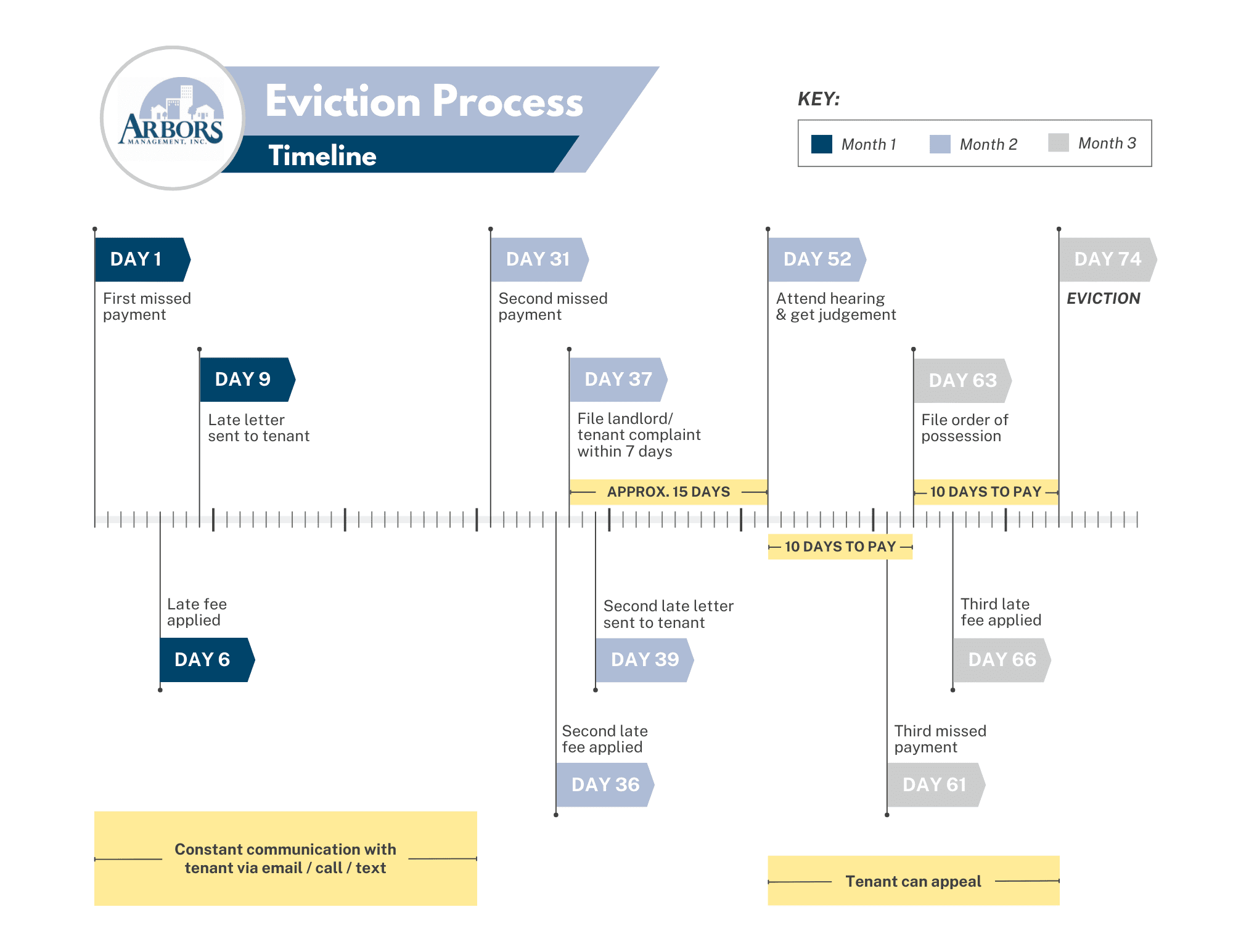
Before the residency even begins, we set the expectations with the resident about how we anticipate rent being paid. We let them know that rent is due on the first. They know when and how to pay it, and they know what the consequences will be if it’s not paid on time.
If payment is not received after the fifth of the month, we assess a late fee. We also send formal letters to the resident notifying them that rent is late. We tell them how much they owe and that we expect an immediate payment. This letter is sent to document the late rent. In addition to the letter, we also call, email, and text residents throughout the month to make sure they understand what they owe and why we are trying to collect it.
Filing a Landlord Resident Complaint
In the event a resident doesn’t pay rent, we file a Landlord Resident Complaint at the local magistrate. Typically, we will file this during the first week of the second month of rent being late. This means it will still be less expensive for the resident to catch up with rent than it would be to move out and find a new place to live.
We receive a court date, and we’ll go to court on your behalf to obtain a judgment in the amount owed plus court fees. Once this judgment is issued, the residents have 10 days to pay the rent. If they don’t pay the full amount within those 10 days, we can file an Order of Possession. Once we do that, the court gives the resident an additional 10 days to pay the rent. The eviction can only commence on the 11th day after the possession order is filed.
Professional Pittsburg Property Management
If the resident appeals the judgment, the case could go to a higher court level. At that point, we would need to involve an attorney. We are professional property managers, but we aren’t attorneys, so we cannot represent you at a higher court.
Many owners want to know what we charge for these services and the time we spend on paperwork and court appearances. The answer is – we don’t believe we should charge you for a bad resident or someone not paying rent. Our philosophy is that you should only be charged on the rent we collect. So, there’s no fee for us filing the Landlord Resident Complaint. The courts do have fees that you’ll be responsible for paying, but those will be passed along to the resident for your reimbursement.
What to Look for In a Property Management Company in Pittsburgh, PA
Property managers often get a bad rap. Why?
Because until recently, the work of a property manager wasn’t taken seriously.
The industry was undeveloped and there wasn’t a lot of training and technology, which led to distrust and bad practices.
But, things are changing.
There’s been a lot of innovation and investment in the property management field, and the best property managers today are doing a lot more than collecting rent and placing residents. We’re managing assets.
We frequently talk to homeowners in Pittsburgh who are moving into a different home or leaving the area for work or other responsibilities who aren’t sure what to do with their property.
Deciding whether you want to sell or rent out your property is a very personal decision and there’s no single answer.
Your decision will depend on a number of factors – contrary to what you might believe, though, not all of these factors involve finances!
Today, we’re going to share some of the points we talk through with owners who are deciding between renting out or selling their home.
#1: Consider Short and Long Term Financial Goals and Needs
If you need some immediate cash fast, it’s better to sell your property.
Renting out a home can build wealth and earn you incredible profits, but it’s not going to happen right away.
You need to settle into a long term investment strategy in order to make real money.
So, if you’re looking for money to use as a down payment on a new home, you want to invest elsewhere, put a child through college, etc.; selling is better for you right now.
However, when you don’t have an immediate need for the equity that’s in your property, it might be better for your financial future to rent out the home.
You’ll earn some regular cash flow and hold onto your asset while it continues to appreciate in value.
Long term investors will earn more by renting out the property.
#2: Think About the Value of a Great Tenant and a Maintained Home
As a rental property, your home has the potential to earn your regular income.
A property with positive cash flow has higher earnings than expenses.
For example:
if you rent out your home for $1,500/month, your mortgage payment is $800 per month, and your taxes, insurance, and other expenses add up to $300 a month, you’re earning a pretty healthy cash flow.
$1,500/ monthYour rental rate
-$800 / monthMortgage payment
-$300 / monthTaxes, insurance, other expenses
$400 / monthCash flow
Even if you’re breaking even with your income and expenses, remember that there are still several benefits to renting out your property:
Your resident is paying down your mortgage
Your asset is increasing in value
Your resident is taking care of the property
If you’re preserving the condition of your property and keeping it occupied with great residents who pay rent on time and follow the terms of your lease, a rental will provide income and ROI for as long as you own it.
#3: Consider Renting the Property for Tax Benefits
Don’t forget the tax benefits of renting out a property!
When you sell a home, you may have capital gains taxes to absorb.
However, when you rent out your property, you can protect yourself from a lot of tax liability.
Depreciation is a deduction you can take, and you can also deduct the costs of maintaining your home.
Additionally, professional services like property management are tax-deductible.
#4: Don’t Forget to Take Emotions into Account
When it comes to a home, there are also some emotional elements involved.
If you can’t bear the thought of someone else living in your home while you’re still attached to it, it may be better to sell and move on.
If you might return to the Pittsburgh area at some point in the future, keep it so you have a place to live when you come back.
We’re Here to Help
We’d be happy to talk through these issues with you, and to figure out the solution that will make the most sense for your bottom line and your peace of mind.
Some of these factors are within your control, while others are not.
Let’s take a look at how each of these factors plays a role in determining your rental property’s value and what you can do to maximize your rental income.
The Pittsburgh Rental Market
One of the things you have no control over is the strength of the current rental market.
Obviously, you’ll hope to earn enough to cover your mortgage and other expenses, all while earning a bit of extra cash every month.
But ultimately, the price you place on your rental home will depend on what’s going on in the rental market – and whether there’s a demand for homes like yours.
Before you price your property, make sure you take a look at the market.
Get to know what homes similar to yours and in your area are renting for.
Do a comparative analysis so you know how your own home measures up.
The whims and preferences of renters often change, and residents are more educated than ever; qualified renters won’t be willing to pay more than what the market dictates.
If you have a single-family home in a neighborhood with a good school system, you’ll be able to charge a lot more than if your property was in a less desirable zip code without access to good schools, commuter routes, shopping, and recreation.
As a general note, properties that are more remote will often rent for less.
Once you’ve bought a property, you don’t have much control over its location; but, location is something to take into account when you’re considering an investment.
Size and Condition of the Property
The size of your home will also impact the price.
For single-family homes, a three-bedroom, two-bathroom home is usually going to earn more than a home with just one bathroom or two bedrooms.
However, a condo or loft space downtown doesn’t need the three bedrooms in order to bring in top dollar rents. In that case, amenities will make more of a difference.
Property condition is actually a factor that you can control; when you allow your property to look worn out and run down, you’re losing rent money.
When considering the condition of your property, an important question to ask yourself is, “Would I live here?”
If your answer is no, you may need to consider some strategic renovations or upgrades that could make your property more desirable.
You’ll be able to charge more in rent when you provide fresh paint, new floors, and even simple improvements like new faucets in the kitchen and bathrooms.
Replace your drawer pulls with brushed nickel, install better lighting, invest in replacing old and nearly-broken appliances with energy-efficient models.
Not only will these minor investments raise your rent, they’ll also attract better residents.
Need Personalized Advice on How Much to Charge in Rent?
We can help!
We’re experts in pricing rental properties in the Pittsburg market. Contact us at Arbors Management for a free consultation and to learn more today!
Arbors Management is a full-service residential property management company serving Pittsburgh and the surrounding areas. You may be asking yourself: who are we? And, what do we do?
We focus on single family homes, multi-unit complexes, and HOA and condo associations. (more…)
Call or text us at (412) 906-4277 during business hours.
We guarantee that a team member will be on the other end to answer any questions you may have.
×
Christopher Wagner
Hello, my name is Christopher Wagner and I am the President of Arbors. I would like to start out by stating that I am very proud of the team here at Arbors and I know that each and every member strives to do the right thing for our clients and make their experiences with Arbors as pleasant as possible. We are first and foremost a service business, and it is important for me to be able to serve our clients and customers with Excellence. I enjoy my job immensely because I truly enjoy seeing growth in others, and in my position I am able to fully support the development of my team; whether this be mentally, emotionally, spiritually, or otherwise. Although I am not too comfortable talking about myself, as I prefer to lead by allowing others to grow and reach their full potential, I understand that sometimes my role requires it.
I have been in the real estate industry since 2000. I obtained my Pennsylvania Real Estate Sales license in 2002, and my Pennsylvania Real Estate Brokers license in 2016. I started out working in the mortgage industry in various roles from 2001 until 2007, at which time I joined Arbors Management, Inc. I have been working for Arbors for 18 years in various capacities, and have been President of Arbors since 2015. I also hold an IST Degree from Penn State, however make great efforts to lead a lifetime of continuous learning.
I also started a development company in 2018. We have completed over $58 million in financing and over $12 million in Construction Management over the past 7 years through the acquisition and redevelopment of multi-unit properties.
In addition, I have served as a Director on the Board of the Apartment Association of Metropolitan Pittsburgh since 2014, and served as President of the association from 2019 through 2021. I previously served as a Director of the Board at ACRE of Pittsburgh from 2003 until 2005.
Furthermore, I am currently the manager of multiple General Partnerships on various multi-unit properties, totaling 717 units throughout Pennsylvania and Ohio.
Finally, In my personal life, I have a fantastic wife, who is my true support in life, and four wonderful children. In addition, I have served in multiple churches in different roles, including as deacon, director of the media team, and various outreach teams. I enjoy giving back as much as possible and living based upon my principles, including making decisions with Integrity, and building a fantastic Community. I also enjoy golfing, pickleball, lakelife, books, and family vacations.
I am very proud of the dedication and hard work of my entire team here at Arbors Management and I would like to introduce my leadership team to you.
×
Get a Free Rental Analysis
×
Get A Free Consultation
×
Trisha Jester
Hello, my name is Trisha Jester and I am the Director of Multifamily Housing here at Arbors Management. I started in the property management business 32 years ago and since then have held various positions, including maintenance, assistant manager, site manager, and regional manager. I have been with Arbors Management for 24 years now. Having the opportunity to work in all aspects of the property management field and be a part of the process from start to finish has provided me with the breadth of knowledge that I need for my current position. I obtained my PA RE License in 1994, and have accumulated many hours of training in Fair Housing, Tax Credit Compliance, and Property Management. One of the things that I love most about my job at Arbors is that my team and I are able to help people who are truly in need of finding affordable housing. Together, the team and I manage over 2,450 units in Western PA and West Virginia. I have been married to my husband, Brad for 26 years, and have two sons, one in college and one a Sargent in the National Guard. On the weekends I enjoy road trips with my husband on our motorcycle, as well as gardening, reading, and cooking.
×
Nick Griffith
Hello, my name is Nicholas Griffith and I am the Director of Business Development here at Arbors Management, Inc. I also serve as the Vice President of Arbors Real Estate, LLC, our real estate sales company. I’ve been with Arbors since 2016, starting as a Portfolio Manager, then serving as the Director of our Scattered Site Properties, and now in my current role. Prior to Arbors Management I had experience in leasing and managing a growing portfolio of 300+ scattered site market rate rental properties. Additionally I also worked in the affordable housing industry as a Certified Occupancy Specialist working on qualifying new residents to move in and various certifications for their residency. During my time here at Arbors I’ve truly enjoyed working with our clients and customers to ensure their satisfaction with our services and my focus has been on perfecting and expanding our services to be the go-to resource for real estate investors. It’s been my pleasure to work with the dedicated and passionate team we have here at Arbors who really care about all the properties, owners, and residents we work with every day. When I’m not breathing all things real estate, you can likely find me at home with my wife, son, and dog. I enjoy the vast restaurant and local brewery options that Pittsburgh has to offer, watching football, hiking, canoeing, exercising, snowboarding, and traveling. I look forward to helping you achieve your real estate goals!
×
Cindy Peterle-Harris
Buon Giorno! I am Cindy Peterle-Harris, the Director of Compliance here at Arbors Management. Although my degrees are in Political Science and the Italian language, I have been working in the affordable housing field since 1980, and with Arbors Management Inc. since 1995: first as a property manager for a senior complex, then as a regional manager, and as the Director of Compliance since 2010. Although it may seem that my education and my profession are worlds apart, I have used my language skills with residents who have limited English proficiency and used the lessons I learned in international diplomacy to maintain peace among neighbors and co-workers. As Director of Compliance, much of my time is spent in research, in teaching, and in problem resolution. I really enjoy working with the managers and staff of our affordable and conventional properties and helping to provide safe and comfortable housing for seniors and families. When not at the office, my husband and I are very involved with our Church and our combined families. With the recent birth of our 10th grandchild, “Grammy” has become my favorite title!
×
Receive Our Free Sample Management Agreement
Fill out the form below:
×
Michael Recklitis
Hi, I am Michael Recklitis and I am the director of maintenance at Arbors Management and have worked for Arbors Management since 1995. I earned a Bachelor of Science Degree in Education and a Master of Science in Marketing Education from the University of Pittsburgh. My state certification in “Building Trades and Maintenance” allowed me to teach many students, who learned the basics of building repair and hand tool usage. I owned a small HUD subsidized apartment building. This ownership helped teach me about subsidized housing, REAC inspection and the required HUD tenant certification needed to rent those units. My position focuses on the physical condition of the many properties managed by the company. I enjoy working as a team member with building staff and have facilitated many property projects with outside contractors and our property staff. I have worked with PHFA Technical Services to complete needed work at other properties that they are involved in. My many interests have included but are not limited to gardening, amateur radio and going to that occasional Penguin, Steelers or Pirate game with my wife. As a boy, I earned the rank of Eagle Scout which helped teach me values and respect. As part of being a scout, I belonged to “The Order of the Arrow” that is Scouting’s National Honor Society which helped strengthen my faith.
×
Eric Miles
My name is Eric Miles and I have been in the real estate industry since 1993. I obtained my Pennsylvania Real Estate Sales license in 1993, and after letting it expire, regained it in 2018 and have received my Brokers License in 2022. I have been intimately involved with mortgages/loans throughout his career with over $150 million of financing obtained for the multiple residential, commercial and office properties. I have worked with two other property management companies with one specializing in residential properties and the other in commercial and office before coming to work with Arbors Management Inc. in 2015 as their Controller. Since then, I have been promoted to Vice President of Operations which oversees the Accounting, Human Resources, Compliance and IT
departments as well as being elected to the Board of Directors.
I currently hold a BSBA in Accounting and a MBA in Finance from Robert Morris University as well as a BS in Real Estate from LaRoche College. In my free time, I enjoy reading and bowling and am often planning my next travel adventure.
×
Allison Park
Avalon
Bellevue
Ben Avon
Bentleyville
Bethel Park
Bloomfield
Brentwood
Bridgeville
Canonsburg
Carnegie
Cheswick
Churchill
Coraopolis
Crafton
Cranberry Township
Delmont
Dormont
East Liberty
Edgewood
Eighty Four
Ellsworth
Emsworth
Etna
Export
Finleyville
Fox Chapel
Friendship
Garfield
Gibsonia
Glenshaw
Greenfield
Greensburg
Greentree
Harmar Township
Harrison City
Highland Park
Houston
Imperial
Irwin
Jeannette
Kennedy Township
Lawrence
Lawrenceville
Leetsdale
Lower Burrell
Manchester
Mars
McCandless
McMurray
Mexican War Streets
Millvale
Monroeville
Moon Township
Mt. Lebanon
Mt. Washington
Murrysville
Muse
North Huntingdon
North Side
North Versailles
Oakland
Oakmont
O’Hara Township
Penn Hills
Perrysville
Pittsburgh
Plum
Point Breeze
Regent Square
Reserve Township
Seven Fields
Sewickley
Shady Side
Sharpsburg
South Hills
South Park Township
South Side Slopes
South Side
Squirrel Hill
Trafford
Upper Saint Clair
Venetia
Verona
Washington
West End
West View
Wexford
White Oak
Whitehall
×
Alex Gurevich
Hello, my name is Alex Gurevich and I am the Director of Maintenance here at Arbors Management. I have over 15 years of maintenance experience working in high rise buildings and multi family complexes. I have been with Arbors since January 2019 and really enjoy working with our team. I have extensive background in electrical, HVAC and plumbing. I also enjoy working with electronics and automation, and have a huge passion for building mechanical systems and love troubleshooting problems.
Cayla has been involved in real estate since 2012. Over the last few years, she has obtained both a Realtors License and a Certified Residential Appraisers license. Additionally, Cayla holds a Bachelor’s degree where she specialized in Business and Management. Always looking to expand and grow, she decided to join the Arbors Real Estate team in 2023. Cayla is dedicated to providing excellent real estate services and looks forward to assisting you with your buying and selling needs!
×
Stacey Oden
Stacey has been with Arbors since 2020 as a property manager- responsible for 200 units. She recently obtained a Realtors License and is excited to help pair buyers and sellers with their perfect investment property, diamond in the ruff or first time home.
×
Jessica Henderson
TBD
×
Tara Morena
I began my journey in real estate in 2006 as a leasing consultant and obtained my real estate license in 2011. Prior to entering the real estate field, I pursued a degree in Hospitality Management, which eventually led me to become a General Manager at Atria’s in Robinson. What I love most about both industries is the opportunity to meet new people. I am married and have two sons, Antonio, aged 11, and Giovanni, aged 7. When I’m not working, I cherish spending quality time with my family, enjoying vacations, and indulging in delicious Italian cuisine!
×
Alexis Cutshall
Alexis has a drive to help others. She recently moved to Arbors Real Estate. LLC. As the Transaction Coordinator and Real Estate Agent. Whether you’re a first-time buyer or looking to sell your property, she changes her approach to meet your unique needs. With years of exceptional customer service, she focuses on building lasting relationships with her clients, ensuring they feel supported every step of the way.
Hello, I’m Andrea Faulk, the Director of Administration and Culture at Arbors Management. Before joining Arbors, I had the wonderful opportunity to spend several years as a stay-at-home mom to my three incredible children. I cherished every moment spent at home with them and my husband of over 26 years, attending to their needs, organizing activities, and coordinating their busy schedules. As they grew older, I realized I wanted to return to the workforce and pursue what I do best: planning, organizing, and executing tasks effectively.
Having served as the Marketing and Office Manager for nearly six years, I can truly express my passion for my role. In this position, I manage a wide range of tasks, including creating and designing our advertisements, organizing events, and overseeing our website.
As the Director of Administration and Culture, I find great joy in applying my organizational skills to create effective systems for each position at Arbors. This approach ensures that everyone has the right tools for success in their roles. I believe that making sure individuals have necessary resources is crucial, but just as important is the expression of gratitude through kind words and taking the time to listen.
×
Brett Windham
Hi, my name is Brett Windham and I am the Director of Human Resources at Arbors Management Inc. I have over 19 years of experience in the field of Human Resources (HR) including; employee relations, employment law, recruiting/onboarding, training, payroll and investigations. I joined Arbors Management in April 2019 with the expectation of building out a robust HR Department and I feel we’ve met that goal and then some! Arbors offers a host of employee-focused events including holiday parties, rewards programs and community events. Additionally, I am a certified PA Notary and hold my BS Degree in Communication from California University of PA (PennWest-California).
My hobbies include cars (working on and driving them), golf (still practicing) and real estate (I have flipped several homes). My wife and I travel as often as we can and we love the outdoors. It is a pleasure to work with the team here at Arbors as everyone here shares the passion of Real Estate and also that of helping each other. It’s a very collaborative environment here and that is what keeps us growing!
×
Kathie Wiskeman
I am Kathie Wiskeman, the Controller at Arbors Management. I have over 30 years of experience in the accounting field, having joined Arbors Management Inc. in August 2003. I am an energetic, results-driven professional with an exemplary history of progressive responsibility. I have a wonderful husband with over 36+ years of marriage and three wonderful children, with seven amazing grandchildren.
My experience includes bookkeeping and property accounting services for privately held, multi-location real estate property management. My duties have covered general accounting functions, including payroll, accounts payable and receivables, general ledgers, trial balance reconciliation, balancing accounts, security deposits, financial reports, year-end tax reports, and various administrative duties. I am proficient in property management software, including Yardi, Boston Post (MRI), AppFolio, and RealPage.
As Controller, I will be focused on applying my accounting skills to create effective procedures for my accounting team at Arbors, streamline financial operations, enhance efficiency, and leverage technology, ensuring they have the necessary tools and information to succeed in their roles.