by Nicole Scimio | Mar 15, 2022 | Blog, Tenant Education
By: Nicole Fandel, Marketing Specialist at Arbors Management
6 Renter Friendly DIY Projects to Make Your Rental Feel More Like Home
There are a lot of perks to renting: you don’t have to worry about home maintenance, you have more flexibility with moving, you’re not tied down by home ownership, etc.
But there are also some downsides to renting – one of them being the feeling that you can’t properly personalize the space or make it your own.
However, there are ways around this! There are renter friendly DIYs that are temporary, cost-effective, and won’t violate the terms of your lease or upset your landlord.
Here are 6 DIY projects that you can do as a resident to make your rental feel more like home:
1. Peel and Stick Backsplash Tile
Does your kitchen need a facelift? Something that is often overlooked but makes a world of a difference is backsplash.
Sounds permanent though, right? Well, it doesn’t have to be.
Yes, there is such a thing as temporary backsplash, and it can take a rental kitchen to the next level. All you have to do is select your tile, peel, stick, and you’re done!
Take a look at this tutorial to get an idea of what materials you need and how the finished product will look. Trust me, you won’t be sorry you did this project.
2. Make a Gallery Wall
Did you know that thousands of famous paintings are considered to be public domain, meaning that you can download high quality files of them for free online?
That’s right, you can find a ton of famous artwork online on websites like this and this and download it all for free, no strings attached. Find a high quality print service in your area, print the artwork at your dimensions of choice, frame, and hang!
To make things even more personal, why not add some of your own pictures into the mix? Pictures of friends, family, pets, anything that makes home feel like home.
3. DIY Artwork
Use an old piece of artwork you have or spend an afternoon at your local thrift shop browsing the aisles and see if you can find a cheap canvas that could use a new look. I’ll admit, this project may take a little more creativity than some of the others, but hey – minimalism is definitely in, so you don’t have to go too crazy!
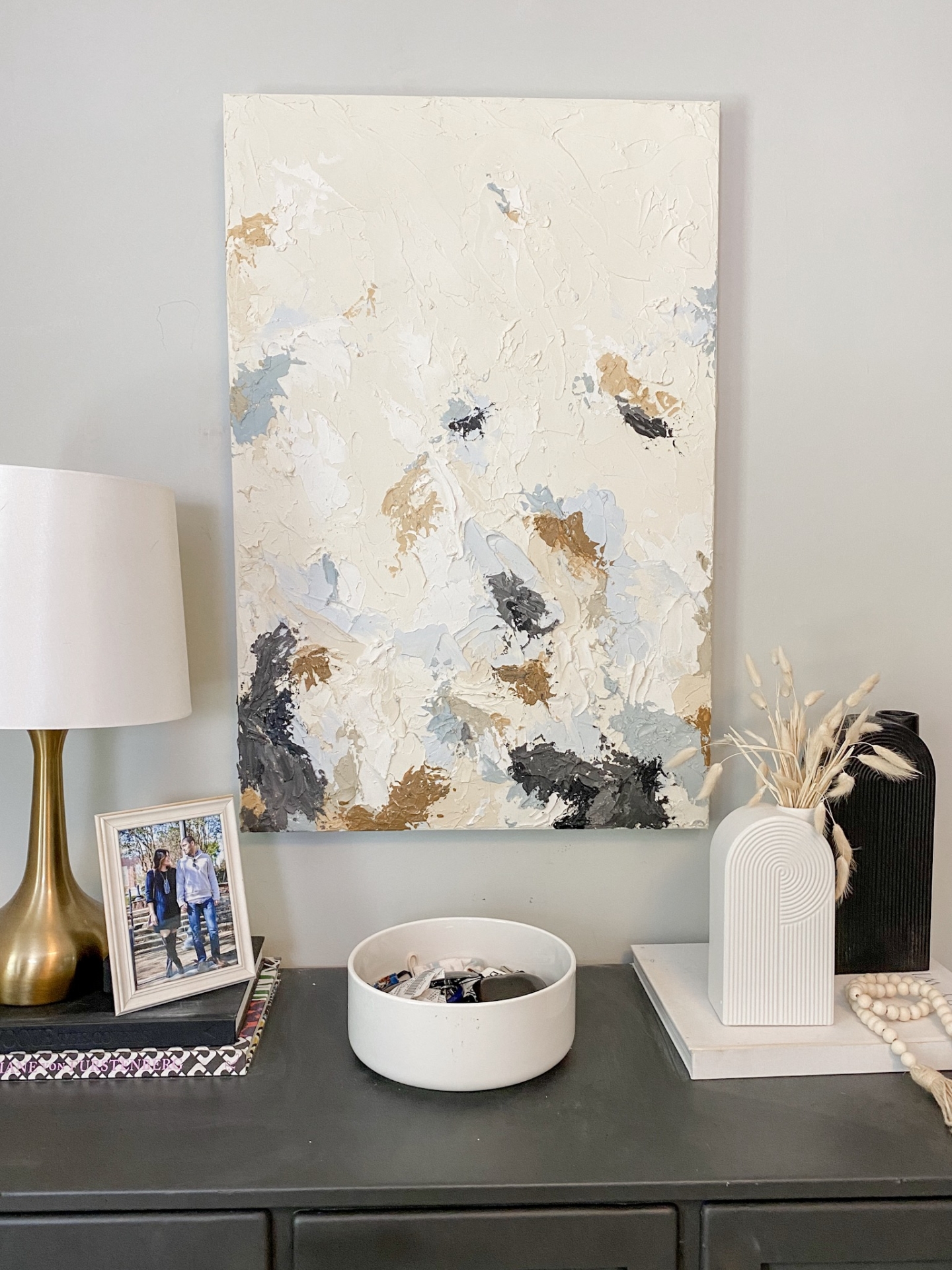
Personally, using spackle and creating a textured piece is one of my favorite techniques to repurpose a canvas that I’ve seen lately. It’s a little messy, but the end result is totally worth it.
4. Revive Old Furniture with Contact Paper
If you’ve been using the same end tables or desks for a number of years now, it’s probably safe to say that they could use a little freshening up.
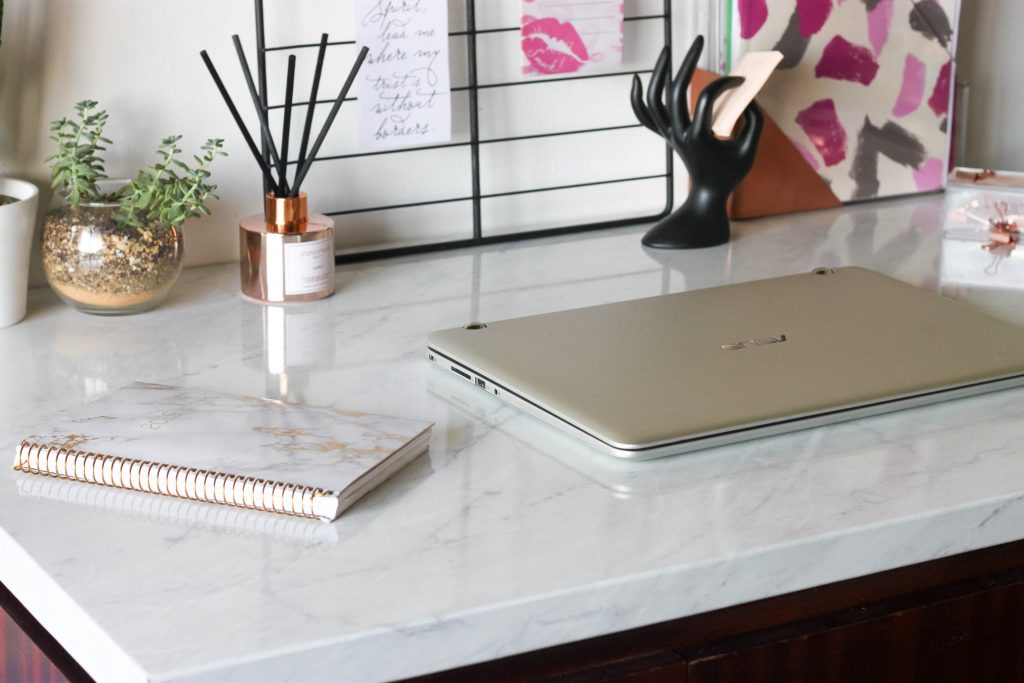
If you’re not familiar, contact paper is an adhesive, decorative paper that can be applied to a variety of surfaces and comes in an array of different patterns – granite, wood, marble, and more – there are a ton of high quality designs to choose from!
For just a little bit of money and a little bit of time, the results are more than satisfying – take a look at this blog post to learn more about resurfacing with contact paper.
5. Refresh Floors with Peel and Stick Tile
As we all know, everyone has different tastes and design preferences, even when it comes to things like flooring. Trends and styles come and go, but changing up something like flooring isn’t always that simple – but now, it can be!
Peel and stick tiles are a great way to bring new life to an outdated floor without ruining what’s underneath – a.k.a., a great temporary fix for renters looking for a change.
If you’re looking for some inspiration on what to do, check out this article on how one man changed the entire style of his kitchen with a few hours and some peel and stick floor tiles.
6. Create an Accent Wall with Peel and Stick Wallpaper
In order to keep things simple and appeal to a range of people, most rental houses/apartments stick with a very basic color scheme on the walls, oftentimes plain white or a very light neutral shade.
Because of this, it can feel like your space lacks character or individuality. However, there is a solution that doesn’t involve a paint can and an upset landlord: peel and stick wallpaper.
Peel and stick wallpaper is available in a ton of different colors and patterns, like regular wallpaper, and can completely change the feeling of a room. With a statement wall like this, both you and your guests will be more than impressed with how personalized your rental home can be.
All in All…
When it comes to personalizing a rental home or an apartment, people often feel stuck, limited, or like they are unable to really make a space feel like home without making major, expensive, permanent changes. But as you read above, that certainly is not the case!
As we discussed above, you can personalize you home as a renter in a variety of different ways:
- Peel and stick backsplash tile
- Creating a gallery wall with prints of artwork and personal pictures
- Creating your own artwork on thrifted canvases
- Using contact paper to liven up old furniture
- Cover up old flooring with peel and stick tiles
- Making an accent wall with peel and stick wallpaper
Even though these changes are temporary, it’s still a good idea to check your lease agreement and with your landlord to ensure that any modifications you make are acceptable. All of these changes are able to be reversed or removed, so make sure you leave your rental the way that you found it once you move out!
All of these projects can be done within a day or two with basic tools and actually are very cost-effective options. So, if you’re looking for fun, inexpensive ways to liven up your rental – you came to the right article. Happy DIY-ing!
by Nicole Scimio | Mar 1, 2022 | Blog, Property Management Education
By: Nick Griffith, Director of Conventional Housing at Arbors Management
What Exactly Do Property Managers Do?
Today, we’ll be speaking about a very simple question that has a complex answer: What exactly do property managers do? The way we see it here at Arbors Management is that property management can be broken down into two main categories – leasing and day-to-day management, and two sub-categories – accounting and compliance.
But, just as important as what property managers do, is what we don’t do; we’ll cover that, too.
How Do We Handle Leasing?
An important part of property management is getting your property leased to a quality renter. Here at Arbors, we believe that most problems in real estate investing can be solved by placing the right, high-quality resident into each property. We perform several types of screening in order to accomplish this; criminal, credit, income, landlord, sex-offender, terrorist, and pet screening, just to name a few.
In order for us to attract the best quality residents, we need to properly market your property by highlighting its features as well as pricing it appropriately.
A good property manager will look at the surrounding market and comparables to determine the best price to rent the property quickly while also giving the owner the best return on their money. We also handle all the inquiries and showings of the property, saving you a lot of time and money.
Once the property manager has found a qualified applicant, they should have a rock-solid lease to ensure that the owner is protected. Here at Arbors, we have a completely online lease signing process, making renting from us easy and efficient.
Once the lease is signed, deposits are paid, and move-in is scheduled, a good property manager will perform a move-in inspection to record the condition of the property at the time the resident moves in. We record the inspection with photos that we can reference again later when the resident decides to move out.
Speaking of inspections, routine inspections are important to ensure your property is well maintained. At Arbors, our leasing specialists perform an interim inspection several months prior to the lease expiration to ensure we know the condition of the property prior to renewing the lease. We share that inspection with our clients along with our recommendations so they can make the best decision for them.
Day-to-Day Property Management – What Does it Look Like?
After the property has been leased and the resident has moved in, we turn to our second category of property management: the day-to-day management.
Perhaps one of the most important items a property manager can do is collect the rent. After all, rent is what allows you to maintain the property and make a profit!
At Arbors Management, we provide several ways for residents to pay their rent; through a convenient online portal, by mail, by drop box at our main office, or by electronic cash payment at several convenient-store locations.
Money management is also a very important part of property management. A property manager will need to pay the expenses on your property, oftentimes from the rent that is collected and bill the residents for any appropriate expenses for your reimbursement.
Once all the expenses are paid, the property manager should have a way to get the investor their money. Here at Arbors, we do a direct deposit into your bank account at the end of each month.
Another aspect of property management is working directly with residents. On occasion, residents will have maintenance requests, emergencies, and general questions or problems while living at the property. These could range from leaky plumbing, heating issues, loss of employment, income changes, additions to their family, or neighbor disputes.
A property manager communicates directly with residents to solve these issues so that you don’t have to. Enforcing a lease can be difficult, so it’s the property managers job to walk the line between being compassionate while also enforcing the agreement. A good property manager should bring you solutions, not problems.
Addressing maintenance issues is another important part of property managers’ duty to maintain the value of your asset. Emergencies can happen at any time, day or night, and even on the weekends.
This is why a good property manager needs to have a plan on what to do when an emergency does happen. Here at Arbors we have a 24/7 dedicated phone number for maintenance emergencies and a network of contractors that can respond quickly in order to resolve any issue that might arise.
How Do Accounting and Compliance Come Into Play?
Two other categories of property management are accounting and compliance.
As an investor, you’ll want to see where your money is being spent and when rents are collected by your property manager. At Arbors, we have a full accounting staff that generates reports so that you can easily see the income for your property, expenses, and any invoices or bills associated with those expenses.
Transparency is important, but so is legal compliance! When renting out a property, there are a lot of laws, rules, and regulations that come with it. Your property manager should know the ins and outs of what is needed at the property to ensure you stay in compliance with these requirements to keep you protected. At Arbors, we have a compliance department that makes sure we cross our t’s and dot our i’s to make sure everyone is protected.
So What Don’t We Do as a Property Management Company?
Almost as important as what property managers do, is what we don’t do. From the information above, we can safely say property managers wear many different hats.
Even though we have many different roles, we are not tax professionals, attorneys, or debt collectors. Oftentimes a property manager can recommend a specialist in each of these areas. We may know a thing or two about each of these topics, but your property manager shouldn’t get involved in areas outside their expertise.
All in All…
The answer to the question “what exactly do property managers do?” is complicated. We discussed how a property manager should handle leasing, day-to-day management, and all aspects involved in those two main categories.
We also discussed that property managers should be transparent with your money through good accounting reports and remain compliant by staying up to date with rental property requirements.
While property managers wear many hats, as they should, they are not tax professionals, attorneys, or debt collectors.
Hopefully you now have a better idea of everything that property management encompasses.
If you have any questions about property management and how Arbors Management might help you with your property(ies), please don’t hesitate to reach out to us!
Phone: 1(800)-963-1280
Email: monroeville@arbors.com